
AI Security Cameras Explained
Posted by Physical Security Gear on 9/4/2026
What Artificial Intelligence Actually Does (and Doesn't Do) in Modern Commercial Video Surveillance
Executive Summary
Artificial intelligence has quickly become one of the most talked-about features in commercial video surveillance.
Every manufacturer seems to advertise AI-powered cameras. Product pages are filled with terms like intelligent analytics, facial recognition, object classification, people detection, license plate recognition, anomaly detection, and machine learning.
It's impressive technology, but it can also be confusing.
For many organizations evaluating a new surveillance system, one question comes up repeatedly:
"Do we actually need AI, or is it just another marketing buzzword?"
The answer depends entirely on what you're trying to accomplish.
Artificial intelligence isn't a replacement for good camera placement, thoughtful system design, or a well-defined security strategy. Instead, it's a powerful tool that helps organizations find information faster, reduce false alarms, improve investigations, and gain operational insights that traditional surveillance systems simply couldn't provide.
Like every technology decision, the goal isn't to purchase the newest feature.
The goal is to determine whether that feature solves a real business problem.
What Is an AI Security Camera?
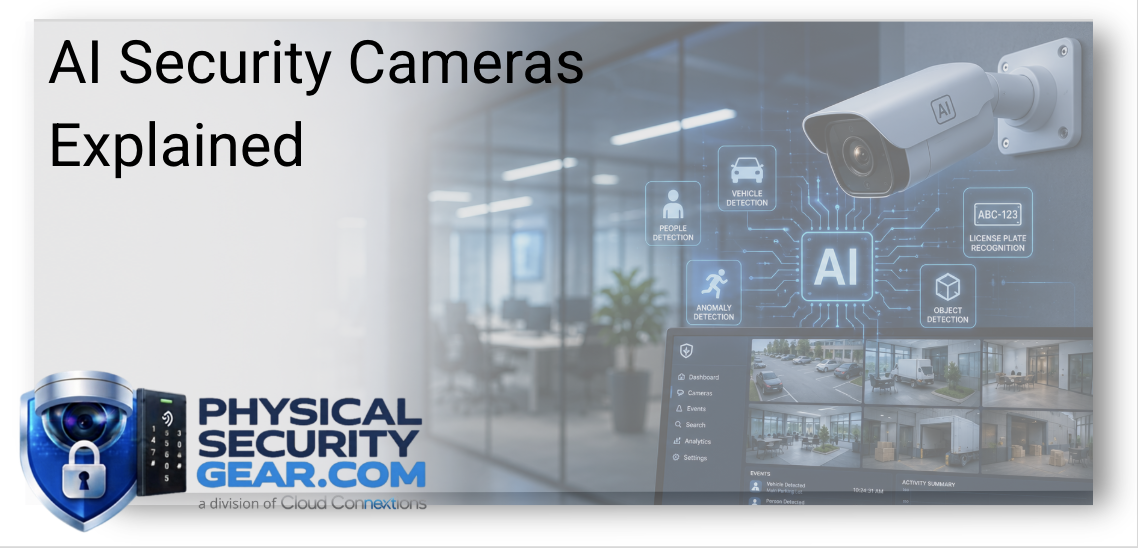
An AI security camera combines high-quality video surveillance with onboard or cloud-based software capable of analyzing what the camera sees.
Rather than simply recording continuous video, AI-enabled systems can recognize patterns, classify objects, identify unusual activity, and help users locate important events in seconds instead of hours.
Think of AI as another member of your security team.
It never gets tired.
It never blinks.
It continuously analyzes activity while allowing your staff to focus on responding to meaningful events rather than manually reviewing hours of footage.
What Can AI Actually Detect?
The capabilities vary by platform, but modern commercial AI cameras can often recognize:
- People
- Vehicles
- License plates
- Faces (where appropriate and legally permitted)
- Animals
- Packages
- Motion direction
- Occupancy levels
- Loitering
- Restricted area entry
- Tailgating through secured doors
- Crowd formation
- Object left behind
- Object removed
These aren't just interesting features.
They're tools that help organizations respond more quickly and make better operational decisions.
AI Is About Finding Information Faster
One of the biggest advantages AI provides isn't recording better video.
It's helping you find the right video.
Imagine someone reports that expensive equipment disappeared sometime Tuesday afternoon.
Without intelligent search, someone may spend hours manually reviewing footage from multiple cameras.
With AI, you may be able to search:
- Person wearing a red shirt
- White pickup truck
- Individual carrying a box
- Activity near loading dock
- Door held open
Instead of reviewing hours of recordings, the investigation may take only a few minutes.
That efficiency becomes increasingly valuable as organizations expand across multiple locations.
Real-World Business Applications
AI often delivers its greatest value outside of traditional security.
We've seen organizations use AI analytics to:
- Monitor warehouse operations.
- Improve loading dock efficiency.
- Understand customer traffic patterns.
- Verify deliveries.
- Monitor restricted laboratory areas.
- Identify safety concerns.
- Detect after-hours activity.
- Assist with workplace investigations.
These operational insights often create just as much value as the security benefits.
AI Doesn't Replace Good System Design
One misconception we hear regularly is that AI can compensate for poor camera placement.
It can't.
If a camera is installed too high, pointed in the wrong direction, or lacks sufficient lighting, artificial intelligence has less information to analyze.
That's why every successful project still begins with thoughtful design.
Camera placement.
Viewing angles.
Lighting conditions.
Operational workflows.
Business objectives.
AI simply enhances a well-designed surveillance system.
What We See Most Often
Organizations sometimes ask us whether they should purchase AI cameras throughout their entire facility.
Our answer is usually:
"Let's first understand where AI creates measurable value."
Main entrances.
Loading docks.
Parking lots.
High-value inventory.
Restricted areas.
These locations often benefit significantly from intelligent analytics.
Other areas may simply require reliable video recording.
Designing the system around your operational priorities usually creates better long-term value than enabling every available feature everywhere.
Advisor's Note
One of the questions we like asking during discovery is:
"If your cameras could answer one question instantly, what would you want that question to be?"
Sometimes it's:
"Who entered this room?"
Sometimes it's:
"Where did this delivery go?"
Sometimes it's:
"Has anyone been in this area after hours?"
Those answers help determine where AI will provide meaningful value and where traditional surveillance may already be sufficient.
Technology should solve operational challenges, not simply introduce new features.
Questions We'd Ask Before Recommending AI
Before recommending AI-enabled cameras, we'd want to understand:
- What operational problems are you trying to solve?
- Which events are most difficult to investigate today?
- Which areas require the fastest response?
- How much video is reviewed each week?
- Will AI reduce administrative workload?
- Do compliance or privacy requirements affect deployment?
- How should AI integrate with access control or visitor management?
Those conversations help ensure the technology supports your organization instead of adding unnecessary complexity.
The Bottom Line
Artificial intelligence isn't replacing security professionals.
It's making them more effective.
When implemented thoughtfully, AI-powered surveillance helps organizations investigate incidents faster, improve operational awareness, reduce manual video review, and make better-informed decisions.
The most successful AI deployments don't begin with technology.
They begin with understanding your people, your facilities, your workflows, and the outcomes you're trying to achieve.
Once those goals are clearly defined, it becomes much easier to determine where artificial intelligence delivers measurable value and where simpler solutions are more appropriate.
That's how we approach every project at PhysicalSecurityGear.com and Cloud Connextions.
We don't recommend AI because it's the newest feature.
We recommend it when it helps your organization operate more securely, more efficiently, and with greater confidence.
Continue Your Research
Continue exploring these related resources:
- Ultimate Guide to Commercial Video Surveillance
- What Makes a Commercial Security Camera Different?
- Dome vs. Bullet Cameras Explained
- Camera Resolution Guide
- Cloud Video Recording Explained
- How to Choose the Right Commercial Security Integrator
- Budgeting a Commercial Physical Security Project