
Basic Intrusion vs. Advanced Intrusion vs. Perimeter Detection
Posted by Doug Beck: Physical Security Gear on 9/16/2026
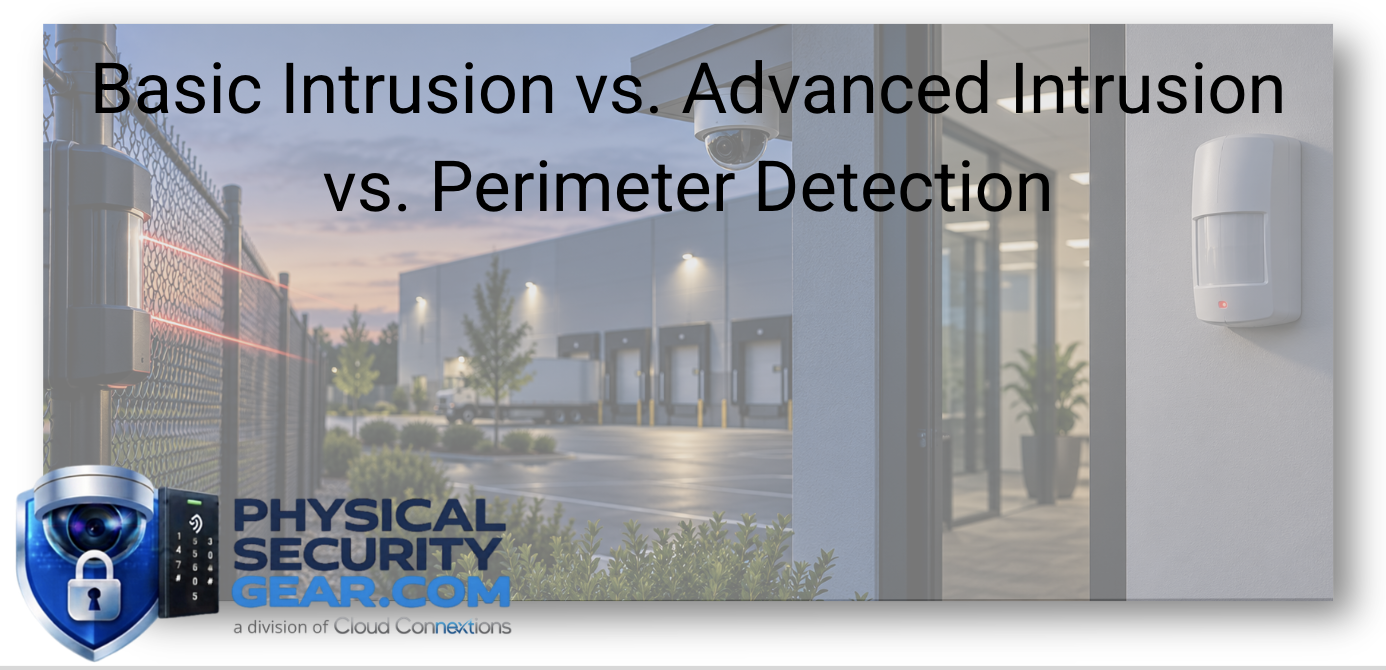
Where Do You Actually Want to Know About a Problem?
Written by Doug Beck
When someone asks me what type of intrusion detection they need, one of the first things I want to know is:
At what point do you want to know something is wrong?
After someone opens a secured door?
When they are moving around inside the building?
When they enter a restricted loading area?
Or before they ever reach the building?
Those are very different security objectives.
A small professional office may only need straightforward protection around doors, windows, and interior spaces after hours.
A warehouse may care just as much about loading docks, equipment yards, and exterior storage.
A dealership, campus, utility property, or manufacturing facility may want to know about activity at the edge of the property before anyone gets close to the building.
That is where basic intrusion, advanced intrusion, and perimeter detection start separating themselves.
I would not begin by asking which system has the most features.
I would begin with:
What are we trying to detect, how early do we need to know about it, and what should happen next?
Start With the Event You Care About
Forget the product for a minute.
What are you actually worried about?
Maybe it is:
- Someone opening an exterior door after hours
- A window being forced
- Motion inside an office that should be empty
- Someone entering a restricted warehouse area
- Activity around a loading dock overnight
- A vehicle entering a closed yard
- Someone crossing into a fenced area
- Movement around outdoor equipment or inventory
All of those could be considered intrusion concerns.
But I would not solve all of them with the same technology.
The farther away from the building you want detection to begin, and the more information you need about the event, the more the architecture may change.
Basic Intrusion: Did Someone Enter?
Basic intrusion is usually the most straightforward place to start.
This is the traditional layer many people picture when they think about an alarm system.
It can include:
- Door contacts
- Window contacts
- Motion sensors
- Glass-break detection
- Alarm panels
- Local audible alerts
For a lot of commercial properties, that may be exactly what is needed.
Think about a professional office that is occupied during normal business hours and locked overnight.
The security question may simply be:
“Did someone open a door, break a window, or move through the building when nobody should be there?”
That is a very different requirement from protecting a 20-acre industrial property.
Basic intrusion can be a good fit when the primary concern is unauthorized activity at or inside the building.
Where Basic Intrusion Stops
The limitation is pretty easy to understand.
A door contact tells you when someone opens the door.
It does not necessarily tell you that someone has been walking around behind the building for ten minutes before they reached it.
For one customer, that may not matter.
For another, those ten minutes could be exactly what they want to know about.
Consider a warehouse with expensive equipment stored outside.
If someone enters the property at 1:00 AM and begins moving through the storage yard, waiting until they reach the rear door may be later than you want detection to begin.
That is when I start looking beyond basic intrusion.
Advanced Intrusion: Give Me More Context
I think about advanced intrusion less as “more alarm devices” and more as better information around the event.
Depending on the system and application, that may include things like:
- Additional detection zones
- Connected sensors
- Remote alerts
- Centralized management
- Video verification
- Automated rules
- Integration with cameras
- Integration with access control
- Better event filtering
Instead of receiving nothing more than:
“Alarm triggered.”
the organization may be able to determine:
Where did it happen?
What triggered it?
Is the area supposed to be occupied?
Can I see video from that location?
Was there an authorized access event at the same time?
That context becomes especially valuable when someone is responsible for several buildings or receives a lot of security events.
More Information Is Only Useful if Someone Can Act on It
This is where I would be careful about buying advanced technology just because it sounds better.
More alerts are not necessarily better.
More sensors are not necessarily better.
More analytics are not necessarily better.
If your team receives 100 notifications and 95 of them mean nothing, we have not improved the security environment very much.
I want the system to make it easier to identify the events that actually deserve attention.
That means understanding:
- What should trigger an alert
- Who receives it
- Whether the response changes after hours
- Whether certain areas deserve higher priority
- Whether video should appear with the event
- What happens if nobody responds
That response workflow matters just as much as the detector.
Perimeter Detection: Move the Security Boundary Outward
Perimeter detection changes where the conversation begins.
Instead of waiting for someone to interact with the building, we are trying to identify activity around the property itself.
That may involve:
- Fenced boundaries
- Outdoor storage
- Loading yards
- Parking areas
- Equipment compounds
- Restricted exterior zones
- Vehicle entrances
- Areas behind or beside the building
Here is the simplest way I explain the difference.
Basic intrusion may tell you:
“Someone opened the rear warehouse door.”
Perimeter detection is trying to tell you:
“Someone entered the restricted yard behind the warehouse.”
Those events might happen several minutes apart.
For some facilities, that earlier warning is extremely valuable.
For others, it would add cost and complexity without solving a meaningful problem.
You Don't Need a Huge Property to Care About the Perimeter
Perimeter detection gets associated with airports, utilities, campuses, and large industrial properties.
Those are obvious applications.
But property size is not really the deciding factor.
A smaller commercial property might have:
- Expensive equipment stored outside
- A recurring trespassing issue
- A loading dock that is vulnerable overnight
- Vehicles stored on-site
- A remote rear parking area
- An exterior delivery location
- Equipment that cannot easily be moved indoors
In those situations, what happens outside the building could be one of the biggest security concerns.
So I would not ask:
“Is our property big enough for perimeter detection?”
I would ask:
“Is there anything happening outside this building that we need to know about before it reaches the door?”
A Simple Way I Would Separate the Three
If we were sitting across the table discussing the facility, I would break it down this way.
Basic Intrusion
I want to know when someone interacts with or enters the protected building.
Think:
Doors, windows, interior motion, straightforward after-hours protection.
Advanced Intrusion
I need more context around the event and more control over how the organization responds.
Think:
Multiple zones, remote management, video verification, connected systems, more sophisticated workflows.
Perimeter Detection
I want to know about suspicious activity before it reaches the building.
Think:
Property boundaries, outdoor assets, loading areas, parking, vehicle entrances, restricted exterior spaces.
You can explore commercial Alarm and Intrusion solutions including Basic Intrusion, Advanced Intrusion, and Perimeter Detection options.
You May Need More Than One Layer
These are not necessarily three competing choices.
A warehouse could use all three concepts without creating an unnecessarily complicated system.
For example:
Outside the property: detect activity entering a restricted storage yard.
At the building: monitor exterior doors and windows.
Inside: detect movement in areas that should be empty after hours.
At the event: use video to help determine what actually happened.
Now the layers are doing different jobs.
That is much more useful than putting five different technologies in the same area simply because they are available.
Where Video Starts Adding Real Value
An alarm tells you something happened.
A camera may help tell you what happened.
That distinction matters.
Suppose an exterior sensor generates an event at 2:15 AM.
Was it:
- A person?
- A vehicle?
- An employee?
- A delivery?
- An animal?
- Weather-related movement?
- Something that actually requires a response?
Being able to see what is occurring can change how quickly and appropriately the event is handled.
If video verification or additional event context is important, explore our Video Security solutions.
I would not add a camera just because there is an alarm sensor nearby.
I would add video where seeing the event changes what you are able to do about it.
Access Control Answers a Different Question
Access control and intrusion are related, but they solve different problems.
Access Control helps answer:
“Was this person authorized to enter?”
Intrusion detection helps answer:
“Is something happening here that should not be happening?”
Put those together and the event becomes much more useful.
A controlled employee door opens at 9:00 AM immediately after an approved credential is used.
That is probably normal.
The same door opens at 2:00 AM with no corresponding authorized access event.
Now we have a very different situation.
The value comes from the systems giving us context rather than every system operating in isolation.
What Happens After the Alarm?
This is one question I think buyers should ask much earlier.
Everyone spends time selecting detectors.
I want to know what happens when one actually goes off.
Does it:
- Sound a siren?
- Notify security?
- Send someone a mobile alert?
- Bring up nearby cameras?
- Escalate if nobody responds?
- Create a different response overnight?
- Notify a monitoring service?
- Trigger another security workflow?
If nobody knows what should happen next, adding more detection does not necessarily make the building safer.
The detection and response should be designed together.
Watch for Alarm Fatigue
One of the fastest ways to make an alarm system less useful is to make it noisy.
People learn to ignore notifications that rarely matter.
If exterior detection is producing constant events from ordinary activity, or every sensor generates the same level of alert, users may eventually stop treating those notifications seriously.
That is why I care about:
What deserves an alert?
Who actually needs to see it?
Can we provide context?
Can different areas have different rules?
Can irrelevant events be reduced?
The goal is not to generate more alerts.
It is to generate alerts that someone can actually use.
Here's How I Would Start the Facility Conversation
Before recommending basic intrusion, advanced intrusion, perimeter detection, or a combination, I would want to understand a handful of things.
What are we protecting?
The building itself? Inventory? Employees? Exterior equipment? Vehicles?
Where are we most vulnerable?
Front entrance? Loading dock? Storage yard? Parking? Interior restricted areas?
How early do we need to know?
After someone enters the building, or before they ever get there?
How much information does the response team need?
Is an alarm enough, or do we need location, video, access events, and other context?
Who receives the event?
A local employee? Corporate security? Facilities? A monitoring service?
What should that person actually do?
This is where the technology has to connect to the operational plan.
Those answers usually tell me more than asking which alarm package the organization wants.
The Bottom Line
Basic intrusion, advanced intrusion, and perimeter detection are really different answers to the same larger question:
Where do you want to know that something is happening, and what do you need to know about it?
Basic intrusion can provide a strong foundation around doors, windows, and interior spaces.
Advanced intrusion can add better context and more sophisticated response workflows.
Perimeter detection can move the warning farther away from the building.
For some facilities, one of those layers is enough.
For others, the right design combines them.
I would not start by buying every available layer.
Start with the risk, decide where detection should begin, and then build outward only where the additional information improves your ability to respond.
Know Which Type of Detection You Need?
Explore commercial Alarm and Intrusion solutions at PhysicalSecurityGear.com.
You can review options for:
- Basic Intrusion
- Advanced Intrusion
- Perimeter Detection
Still Trying to Determine Where Detection Should Begin?
Use the chat on our site and tell us:
- What type of facility you have
- What you are trying to protect
- Where your biggest concerns are
- Whether exterior property is involved
- What you would want to know if something happened after hours
- Whether cameras or access control are already installed
Our team can help narrow down the right detection approach before you start purchasing sensors and alarm equipment.
Sometimes the answer is a straightforward intrusion system.
Sometimes the real opportunity is moving detection farther outside.
And sometimes the existing system simply needs better context around the events it already detects.
Continue Your Research
- Why Cybersecurity Matters in Physical Security
- What Do You Actually Need for a Commercial Access Control System?
- Ultimate Guide to Commercial Video Surveillance
- How Many Security Cameras Does My Building Actually Need?
- How to Secure Deliveries, Loading Areas, and Employee Entrances
- 25 Questions Every IT Director Should Ask Before Buying Security Technology