Budgeting a Commercial Physical Security Project
Posted by Physical Security Gear on 9/1/2026
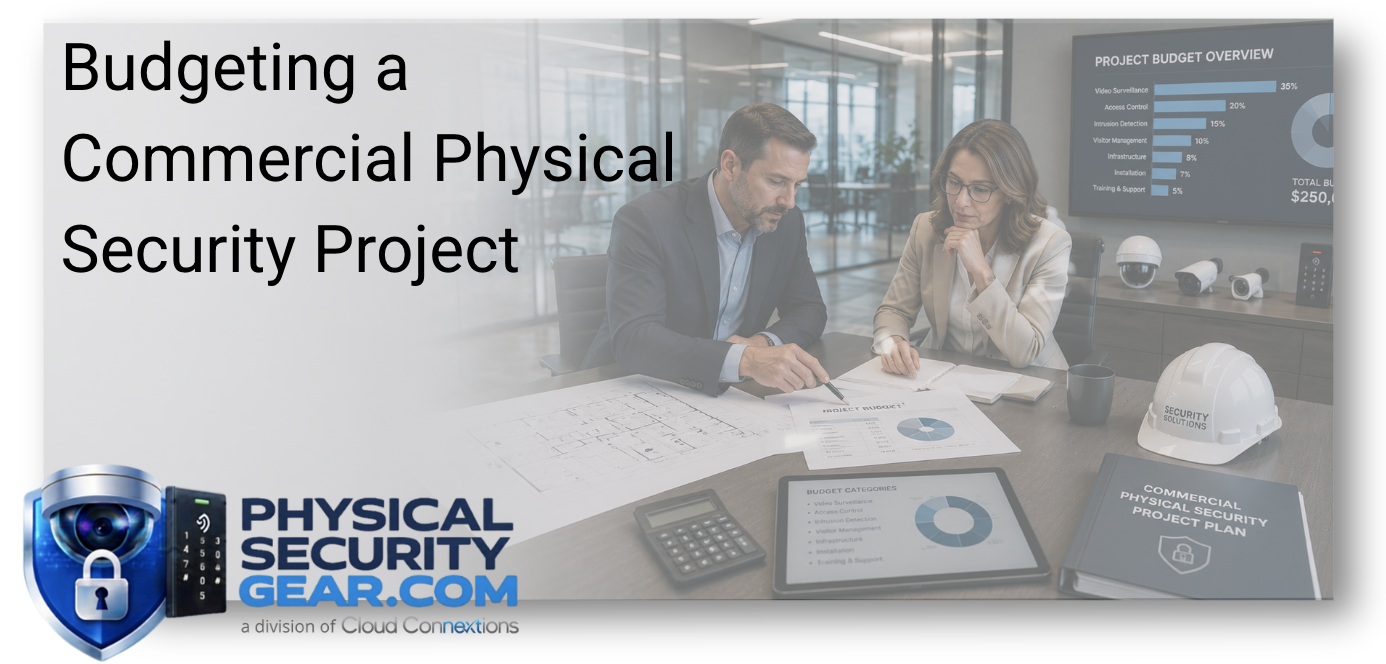
How to Build a Budget That Solves Today's Problems Without Limiting Tomorrow's Growth
Executive Summary
Creating a budget for a commercial physical security project isn't simply about determining how much money to spend.
It's about making strategic investments that improve security, simplify operations, and support your organization's long-term growth.
Many organizations begin by asking for pricing on cameras, badge readers, or access control hardware.
Those are reasonable questions, but they're usually being asked too early.
The most successful projects begin by understanding the business first.
How does your organization operate today?
What operational challenges are creating the most frustration?
Which workflows could be simplified?
How will your facilities change over the next five to ten years?
Answering those questions before requesting proposals often leads to a better-designed solution, fewer surprises during implementation, and a significantly better return on your investment.
Our role isn't simply to recommend products.
It's to understand how your organization operates and design a security platform that supports your people, your facilities, and your long-term business objectives.
Start With Business Objectives, Not Equipment
One of the biggest mistakes organizations make is budgeting for hardware before defining what success actually looks like.
Security technology should support a business objective.
That objective might be:
- Replacing an aging access control system.
- Improving employee and visitor safety.
- Standardizing security across multiple offices.
- Supporting future expansion.
- Eliminating physical keys.
- Improving investigations with integrated video.
- Simplifying visitor management.
- Reducing the administrative burden on IT and Facilities.
When those goals are clearly defined, choosing the right technology becomes much easier.
A Real-World Budget Example
One of the questions we hear most often is:
"Can you give us a ballpark number?"
The answer is yes, once we understand the project.
To provide a realistic example, we recently designed a cloud-managed access control solution for a customer securing four commercial doors.
The proposal included:
- Cloud-managed access control platform
- Four commercial card readers
- Four electric strikes (based on the existing door conditions)
- Controllers
- Required hardware
- Programming and commissioning
- One year of cloud licensing
- Professional installation by our integration team
The total first-year investment was just over $30,000, including equipment, software licensing, implementation, and installation.
From there, the customer wanted additional visibility at each entrance.
By adding commercial security cameras to each controlled opening, they created a system capable of verifying not only which credential unlocked the door, but also who actually entered the building.
That integrated solution increased the total first-year investment to approximately $40,000, including cameras, analytics, licensing, installation, and system integration.
Later in the planning process, we also discussed adding a cloud-managed video intercom for visitor communication and remote entry.
That enhancement added approximately $2,500 to the overall project.
The important takeaway isn't the exact number.
It's understanding how the scope evolves based on operational goals rather than simply adding products.
Every Building Is Different
It's important to remember that these numbers represent one specific project.
Another organization with four doors could require a very different solution.
Why?
Because every building is different.
Some doors can utilize electric strikes.
Others require magnetic locks.
Emergency exits may require electrified panic hardware.
Glass storefront entrances often require completely different locking solutions.
Existing cabling, power availability, building construction, life-safety codes, and aesthetic expectations all influence the final design.
That's why we spend time understanding the building before recommending equipment.
Budget for the Entire Security Ecosystem
Physical security creates the greatest value when systems work together instead of operating independently.
Rather than budgeting separately for access control, surveillance, visitor management, intercoms, and analytics, we encourage organizations to think about how those technologies support one another.
For example:
- Access control tells you which credential opened the door.
- Video surveillance verifies who actually entered.
- Visitor management documents who was expected to be there.
- AI analytics reduce the time required to investigate events.
- Cloud management allows every location to operate under the same security standards.
Each technology solves part of the problem.
Together, they create a complete operational security platform.
Think Beyond Today's Budget
One of the conversations we have with nearly every client involves future growth.
Maybe today's project includes one office.
Next year it may include another floor.
The following year it may include three additional locations.
That's why we often recommend building a security standard instead of simply completing a project.
Once we've evaluated your facilities, selected the appropriate platform, standardized door hardware where possible, and documented your operational workflows, we can often establish a realistic per-door investment specific to your environment.
That makes future budgeting dramatically easier.
Leadership can begin forecasting expansion costs with much greater confidence because the foundation has already been established.
Instead of redesigning every project from scratch, future deployments become repeatable, consistent, and significantly more predictable.
What We See Most Often
Organizations rarely regret spending time planning.
They regret skipping it.
Many of the projects we design begin with a request for pricing.
After spending time understanding how the business actually operates, the solution often changes.
Sometimes existing infrastructure can be reused.
Sometimes another department has similar needs, creating opportunities to combine projects.
Sometimes we recommend implementing access control today while preparing the platform for cameras, visitor management, or intercoms later.
Those recommendations aren't driven by products.
They're driven by operational efficiency and long-term value.
Advisor's Note
One of the biggest differences between buying products and designing a security strategy is the conversation.
If the first discussion focuses on hardware, you'll probably receive a hardware quote.
If the first discussion focuses on your people, your workflows, your facilities, and your operational goals, you'll likely receive a solution that continues creating value long after installation.
That's the approach we've found creates the most successful long-term partnerships.
Questions We'd Ask Before Building a Budget
Every organization is different, but our discovery process typically begins with questions like:
- What prompted this project?
- Which operational challenges are you trying to solve?
- How many locations are involved today?
- Are additional locations planned?
- Which departments will use the system?
- What does success look like one year after implementation?
- Where do you see your business three to five years from now?
Those conversations help us recommend solutions that fit your organization instead of forcing your organization to fit the technology.
The Bottom Line
Budgeting a commercial physical security project isn't about finding the lowest number.
It's about building a solution that protects your people, supports your operations, and gives your organization the flexibility to grow with confidence.
The best budgets aren't built around cameras, card readers, or door hardware.
They're built around your business.
Once we understand your workflows, operational priorities, facilities, and long-term vision, we can design a solution that's tailored to your environment and establish a repeatable standard that makes future expansion easier and more predictable.
That's how we approach every project.
Not by asking, "What products should we sell?"
But by asking, "What does this organization need to operate more securely and more efficiently?"
Continue Your Research
Continue exploring these related resources:
- Ultimate Guide to Commercial Access Control
- How Much Does Commercial Access Control Cost?
- How to Choose the Right Commercial Security Integrator
- Ultimate Guide to Visitor Management
- 25 Questions Every IT Director Should Ask Before Buying Security Technology