
Do You Need License Plate Recognition Cameras?
Posted by Doug Beck: Physical Security Gear on 9/21/2026
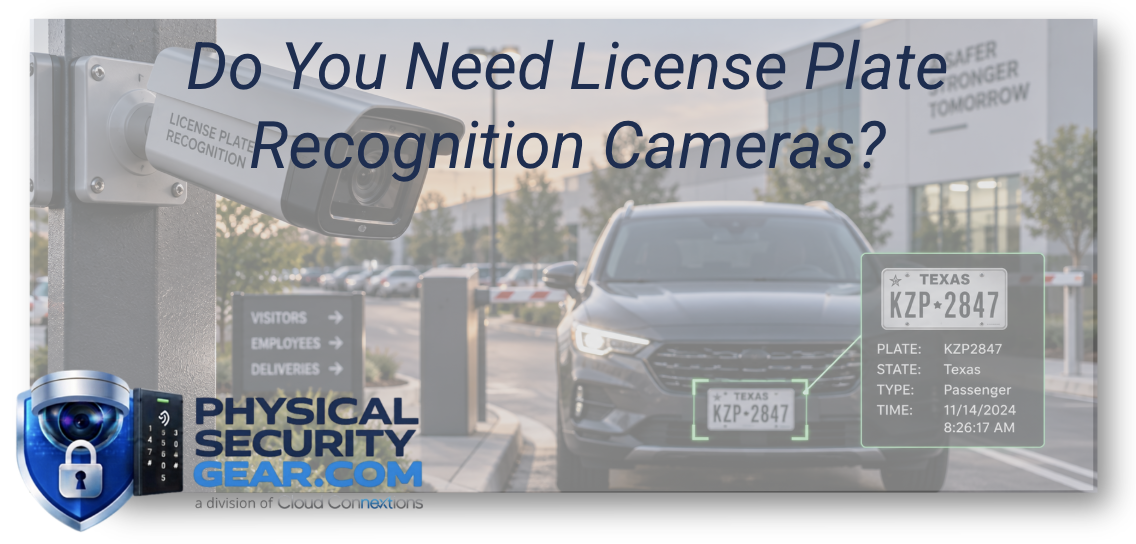
Why Capturing a Vehicle Is Not the Same as Capturing Its Plate
Written by Doug Beck
A customer can have a great view of a parking lot and still not be able to answer one very important question:
What was the license plate?
That surprises people.
They pull up recorded video, clearly see the vehicle, recognize the color and body style, and maybe even watch it enter and leave the property.
Then they zoom in on the plate.
Nothing useful.
That does not necessarily mean the camera is bad.
It usually means the camera was designed to watch the parking lot, not specifically to capture license plates.
Those are two different jobs.
If license plates matter to your security plan, I would decide that before choosing the camera.
Start With Why You Want the Plate
License plate recognition, often referred to as LPR, can be useful for much more than investigating theft after the fact.
Organizations may want plate information for:
- Parking lot investigations
- Vehicle entrances and exits
- Gated facilities
- Campuses
- Industrial properties
- Warehouses and distribution centers
- Apartment or multifamily properties
- Employee parking
- Restricted areas
- Known or unauthorized vehicle alerts
But I would not start by asking whether you need “LPR.”
I would ask:
What do you want to do with the plate once you capture it?
Maybe you simply want clearer evidence after an incident.
Maybe security wants to search for a vehicle that visited three days ago.
Maybe a gated facility wants to identify recurring vehicles.
Maybe the organization wants alerts when a vehicle of interest enters the property.
Those are different workflows.
The technology should support the workflow rather than becoming the reason for it.
Seeing the Vehicle Is the Easy Part
A general parking-lot camera may provide excellent situational awareness.
You can see:
where the vehicle parked,
when it arrived,
who got out,
where the person walked,
and when the vehicle left.
That is valuable footage.
But the plate occupies a very small portion of the overall image.
If the camera is mounted high, aimed across a wide parking area, and capturing dozens of vehicles at once, you should not automatically expect readable plate detail from every vehicle in the scene.
This is where people can get fooled by camera resolution.
They see “4K” and assume they will be able to zoom into anything.
Resolution helps, but it does not eliminate distance, angle, movement, or lighting.
We covered that broader issue in 2MP vs. 4MP vs. 8MP Security Cameras.
Doug's Rule: Create a Choke Point
If plate capture is important, I would much rather design around a predictable place where vehicles have to pass.
Think:
A parking-lot entrance.
A gated driveway.
A garage entrance.
A service road.
A controlled exit.
Now I know where the vehicle should be.
I know roughly which direction it will travel.
I can control the camera angle much more effectively.
And I can design the shot around the plate instead of trying to find a tiny plate somewhere inside a massive parking-lot image.
That is a much better starting point.
Angle Matters More Than Buyers Expect
Imagine pointing a camera almost straight down a driveway.
Now compare that with a camera mounted far off to the side.
Both may see the same vehicle.
But the plate may look very different.
As the viewing angle becomes more extreme, the plate becomes harder to capture cleanly.
The same thing happens vertically.
A camera mounted extremely high may provide excellent general coverage while looking steeply down onto vehicles.
That can work against the plate view.
This is why the best parking-lot overview location is not always the best license-plate location.
Sometimes you need both.
Do Not Ask One Camera to Do Two Opposite Jobs
This comes up repeatedly in security design.
The customer wants one camera to:
watch the entire entrance,
cover the parking lot,
see pedestrians,
identify vehicles,
and read plates.
Maybe it can do some of those things.
But every time we make the field of view wider, the plate generally occupies less of the image.
So instead of searching for one magical camera, I may recommend:
One camera for overall context.
One camera dedicated to the vehicle path.
The overview tells you what happened.
The plate camera helps tell you which vehicle was involved.
Together they tell a much stronger story.
Vehicle Speed Changes the Problem
A vehicle entering a controlled parking lot at low speed is one application.
A vehicle traveling much faster down a roadway is another.
Movement affects the camera's ability to capture useful detail.
That means I want to know:
How fast are vehicles typically moving?
Do they stop at a gate?
Do they turn before entering?
Do they slow for a speed bump?
Can the camera be positioned where vehicle behavior is predictable?
Sometimes a small change to the camera location can make the application much easier.
Daytime Success Does Not Guarantee Nighttime Success
This is a big one.
You test the camera at 2:00 PM.
The plate looks great.
Then a vehicle enters at 10:30 PM with headlights pointed toward the camera.
Completely different environment.
Nighttime plate capture introduces challenges such as:
- Headlights
- Reflective plates
- Limited ambient lighting
- Vehicle motion
- Deep shadows
- Changing weather
If plate information matters around the clock, I would test the application around the clock.
Do not judge the system only under the easiest lighting conditions.
More Megapixels Are Not the Whole Answer
We have already covered why I do not select cameras by megapixel count alone.
LPR is a great example.
An 8MP camera capturing an extremely wide parking lot may provide less useful plate detail than a more intentionally designed camera capturing a narrower vehicle lane.
That is not because 8MP is bad.
It is because the second camera is using its image much more intentionally.
The question is not:
How many pixels does the camera have?
It is:
How many useful pixels are actually on the plate at the moment we need them?
Optical Zoom Can Help You Build a Better View
When the camera cannot be mounted close to the vehicle path, stronger optical capability may become important.
A narrower or telephoto view can help concentrate the image on the area where vehicles pass.
That can be particularly useful when:
- Entrances are far from the building
- Cameras must be mounted on existing structures
- Large commercial properties have long driveways
- Installation locations are limited
But there is a tradeoff.
Narrowing the view means seeing less of the surrounding environment.
Again, that is why I like giving the camera one clear job.
Plate Recognition and Plate Capture Are Not the Same Thing
This distinction matters.
A camera may capture an image where a human can read the plate.
An LPR system can potentially go further by converting the plate into searchable information.
Depending on the platform, that can support workflows such as:
searching recorded vehicle activity,
finding repeat visits,
reviewing vehicles by plate,
or creating alerts around specific vehicles.
Those capabilities vary by platform.
So if searchable plate information is important, I would verify the actual software workflow rather than assuming any camera that produces a clear image automatically provides full LPR functionality.
Think About What Happens After the Search
This is where the business use case becomes more interesting.
Suppose an employee reports that something was stolen from their vehicle.
The organization knows approximately when the incident occurred.
With useful video coverage, investigators may be able to determine:
which vehicles were nearby,
when they entered,
where they traveled,
and when they left.
If plate information is searchable too, the investigation may become considerably easier.
The value is not just collecting another piece of data.
It is shortening the path from:
“Something happened.”
to
“Here is the vehicle we need to investigate.”
Plate Data Deserves a Cybersecurity Conversation Too
Once a surveillance platform begins collecting searchable information about people or vehicles, the security of the system itself becomes increasingly important.
Who can access the information?
How are user permissions managed?
How long is the information retained?
How is access audited?
How are accounts removed when employees leave?
Those are not reasons to avoid LPR.
They are reasons to manage it responsibly.
For the broader discussion, see Why Cybersecurity Matters in Physical Security.
Retention Matters During Vehicle Investigations
Think about how vehicle incidents are actually discovered.
Some are reported immediately.
Others are not.
An employee may notice damage hours later.
Inventory may be discovered missing during a weekly review.
An unauthorized vehicle may only become relevant after another incident occurs.
That means your ability to search historical vehicle activity is affected by how long the video remains available.
If retention has not been determined yet, read How Long Should You Keep Security Camera Footage?.
The camera and retention strategy should support the same investigation window.
Do You Need LPR at Every Entrance?
Probably not.
I would identify the vehicle paths where plate information has actual value.
Perhaps that means:
the primary vehicle entrance,
a restricted loading entrance,
a parking garage,
or the driveway into a secured property.
Installing specialized coverage everywhere simply because the technology exists can increase cost without improving the security outcome.
Start with the risk.
Then identify where plate information would actually change the response.
What About Gated Vehicle Access?
This is where cameras and access control can begin intersecting.
Some facilities manage vehicle entry using:
- Access credentials
- Gate controls
- Intercoms
- Security personnel
- Vehicle identification
- Combinations of those technologies
If the organization is already planning an entrance-control project, I would evaluate the complete vehicle workflow rather than treating the camera as an isolated purchase.
Who is allowed in?
How is access granted?
What happens to visitors?
What happens after hours?
What evidence do we need if something goes wrong?
Those questions may involve both Video Security and Access Control.
Existing Cameras May Still Play an Important Role
Adding LPR does not mean your current parking-lot cameras become useless.
Quite the opposite.
The existing camera may provide excellent context.
The new camera provides the specialized plate view.
When investigating an incident, you may use the plate camera to identify the vehicle and the wider cameras to understand everything that vehicle did after entering the property.
That is a stronger system than trying to force one camera to provide both views.
Before replacing otherwise useful equipment, read Can I Reuse My Existing Security Cameras?.
What I Would Want to Know Before Recommending LPR
If you asked me whether license plate recognition makes sense for your property, I would want to know:
- Why you need the plate information
- Number of vehicle entrances and exits
- Approximate vehicle speed
- Whether vehicles stop or slow down
- Camera mounting options
- Distance from the camera to the vehicle path
- Daytime and nighttime lighting
- Whether you need readable plates or searchable plate analytics
- Existing video platform
- Retention requirements
- Whether gates or access control are involved
Those answers usually tell us whether we are solving a real business problem or simply adding a feature.
The Bottom Line
License plate recognition can be extremely useful.
But a general security camera that happens to see vehicles is not automatically an LPR solution.
Reliable plate capture depends on designing for the plate.
That means considering:
Vehicle path.
Distance.
Angle.
Speed.
Lighting.
Lens.
Camera placement.
Software.
Retention.
Start with where vehicles predictably enter or leave.
Then decide what information your security team actually needs from them.
The goal is not merely to see the car. It is to capture the identifying information that makes the vehicle useful during an investigation.
Trying to Capture Vehicles or License Plates?
Send us a photo of the entrance or driveway along with approximate distances, vehicle direction, mounting options, and what you need to identify.
We can help determine whether the application needs general vehicle coverage, a dedicated plate view, LPR functionality, or a combination.
Start with Video Security to compare commercial camera options. For larger outdoor environments, PTZ Cameras and other specialized camera architectures may also play a role in the broader surveillance design.
Continue Your Research
- 2MP vs. 4MP vs. 8MP Security Cameras
- How Many Security Cameras Does My Building Actually Need?
- Can I Reuse My Existing Security Cameras?
- How Long Should You Keep Security Camera Footage?
- Why Cybersecurity Matters in Physical Security
A parking-lot camera tells you a vehicle was there. A properly designed LPR application can help tell you which vehicle it was.