
Dome vs. Bullet Security Cameras
Posted by Physical Security Gear on 9/5/2026
Which Commercial Security Camera Is Right for Your Building?
Executive Summary
One of the first questions organizations ask when planning a commercial video surveillance project is surprisingly simple:
"Should we use dome cameras or bullet cameras?"
It's a great question, but it doesn't have a one-size-fits-all answer.
Both styles of cameras are widely used in commercial environments. Both can deliver exceptional image quality, support advanced AI analytics, and integrate with modern cloud-managed security platforms.
The difference isn't which one is "better."
The difference is where each camera performs best.
Choosing the wrong camera style won't necessarily make your security system fail, but it can affect image quality, aesthetics, maintenance, coverage, and ultimately how useful your video becomes when you actually need it.
That's why we rarely begin by asking which camera you prefer.
Instead, we begin by understanding what you're trying to see, where the camera will be installed, and how the information will be used.
The camera is simply the tool. The business objective determines which tool is the right fit.
Start With the Environment
A loading dock has different surveillance requirements than a corporate lobby.
A parking lot presents different challenges than a conference room.
A school hallway differs from a warehouse aisle.
Rather than selecting cameras based on appearance, start by asking:
- What area are we monitoring?
- What level of detail is required?
- How visible should the camera be?
- Will it be installed indoors or outdoors?
- What lighting conditions exist throughout the day?
- Should the camera deter unwanted activity or operate more discreetly?
These answers often determine the right camera style before discussing manufacturers or specifications.
When Bullet Cameras Make Sense
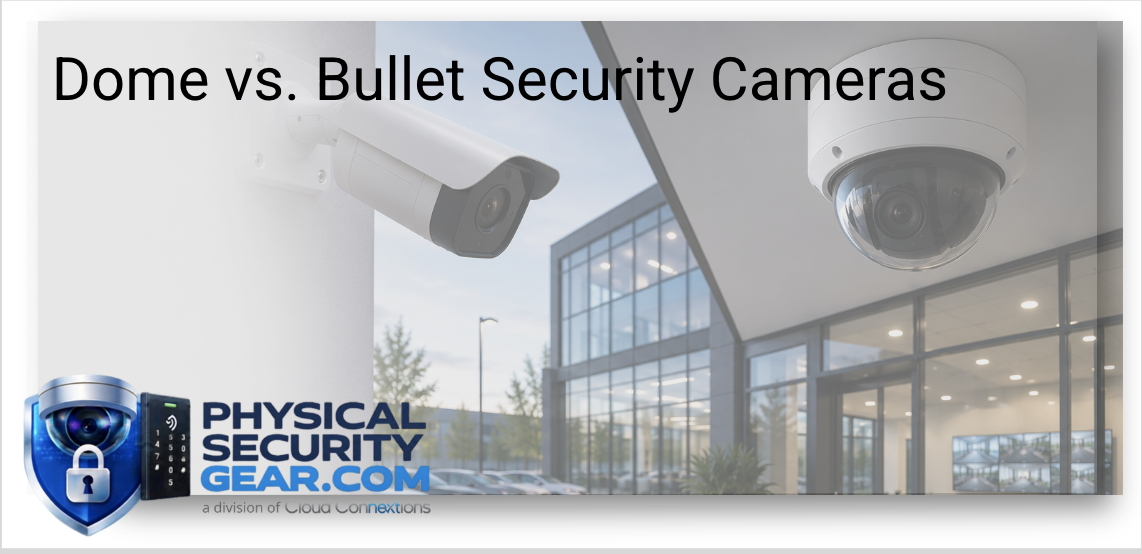
Bullet cameras are easily recognizable by their elongated housing and highly visible mounting position.
Because they're easy to point toward a specific area, they're commonly used when organizations want to clearly monitor a defined space.
Common applications include:
- Building entrances
- Parking lots
- Perimeter fencing
- Loading docks
- Exterior walkways
- Drive lanes
- Shipping and receiving
Their visibility can also act as a deterrent.
Someone approaching a facility generally has little doubt they're being monitored.
That alone can discourage unwanted activity.
When Dome Cameras Make Sense
Dome cameras have become one of the most popular options for commercial interiors.
Their compact design blends naturally into modern office environments while making it more difficult for someone to determine exactly where the camera is aimed.
You'll often see dome cameras in:
- Office lobbies
- Reception areas
- Hallways
- Conference rooms
- Schools
- Healthcare facilities
- Retail environments
- Common workspaces
Because they sit close to ceilings, dome cameras often provide a cleaner architectural appearance while remaining highly effective for everyday surveillance.
It's About More Than Appearance
Many buyers assume the only difference is aesthetics.
In reality, camera selection should also consider:
- Viewing angle
- Mounting height
- Weather exposure
- Vandal resistance
- Maintenance accessibility
- Lighting conditions
- Field of view
- Future AI analytics
For example, a camera monitoring a long parking lane may benefit from a different lens than one covering a reception desk.
Likewise, an indoor camera designed to identify visitors entering a lobby has very different objectives than one monitoring warehouse traffic.
The camera housing is only one part of the design conversation.
What We See Most Often
One of the most common mistakes we encounter is assuming every camera throughout a facility should match.
While consistency can create a clean appearance, the best-performing surveillance systems often use multiple camera styles.
A single project may include:
- Bullet cameras protecting the exterior perimeter.
- Dome cameras throughout office interiors.
- Multi-sensor cameras covering large open areas.
- PTZ cameras monitoring expansive parking lots.
- Specialty cameras supporting loading docks or manufacturing spaces.
Each camera is selected because it performs a specific job well.
The result is a system designed around the building rather than around a product catalog.
Advisor's Note
One question we often ask clients is:
"If an incident occurred here tomorrow, what information would you want this camera to capture?"
That simple question changes the discussion.
Instead of choosing cameras based on appearance, we begin selecting them based on the information your team actually needs.
Sometimes that leads to a dome camera.
Sometimes it's a bullet camera.
Sometimes it's neither.
The goal isn't uniformity.
It's designing a surveillance system that gives your organization the clearest possible picture of what's happening across your facilities.
Questions We'd Ask Before Recommending a Camera Style
Before selecting any commercial camera, we'd typically ask:
- Is the camera indoors or outdoors?
- Is visual deterrence important?
- What level of identification is required?
- Are AI analytics part of the project?
- Will cameras integrate with access control?
- What lighting challenges exist?
- Are aesthetics important in customer-facing areas?
- Is vandal resistance a concern?
- Will the system expand over time?
Those conversations help ensure every camera serves a purpose instead of simply filling space on a floor plan.
The Bottom Line
Choosing between dome and bullet cameras isn't about selecting a winner.
It's about selecting the right tool for the environment.
The most successful surveillance systems are designed around your building, your operational workflows, and the information your organization needs to make informed decisions.
Sometimes that means installing bullet cameras around the perimeter and dome cameras inside.
Sometimes it means incorporating PTZ or multi-sensor cameras where broader coverage is required.
The best design is rarely based on one camera style.
It's based on understanding how your business operates and building a surveillance system that supports it today while remaining flexible enough to grow tomorrow.
Continue Your Research
You may also find these resources helpful:
- Ultimate Guide to Commercial Video Surveillance
- What Makes a Commercial Security Camera Different?
- AI Security Cameras Explained
- PTZ Cameras Explained
- Multi-Sensor Cameras Explained
- Camera Resolution Guide
- Cloud Video Recording Explained