
Electric Strike vs. Magnetic Lock: Which Is Right for Your Access Control System?
Posted by Doug Beck: Physical Security Gear on 9/23/2026
The Reader and Credential Get the Attention. The Door Hardware Is What Has to Actually Work.
Written by Doug Beck
When people start shopping for access control, they usually focus on the visible parts first.
The card reader.
The mobile credential.
The keypad.
The software.
Those are important.
But when somebody presents an approved credential, something still has to physically release the door.
That is where electric strikes, magnetic locks, electrified hardware, request-to-exit devices, door contacts, power supplies, and the existing door hardware all start becoming part of the project.
And this is one of the places where I would be careful about buying access control equipment before somebody actually looks at the door.
Two doors twenty feet apart may need completely different hardware.
Start With the Existing Door
If I am walking a facility, one of the first things I want to see is what is already there.
Is it a wood door?
Hollow metal?
Glass storefront?
Aluminum frame?
Double door?
Fire-rated opening?
Does it already have panic hardware?
How does someone currently exit?
What condition is the frame in?
Does the door close and latch correctly?
Those details matter.
Access control does not fix a door that already has mechanical problems.
If the door does not close properly today, adding electronics to it can create a more expensive version of the same problem.
Before choosing the lock, understand the opening.
What Is an Electric Strike?
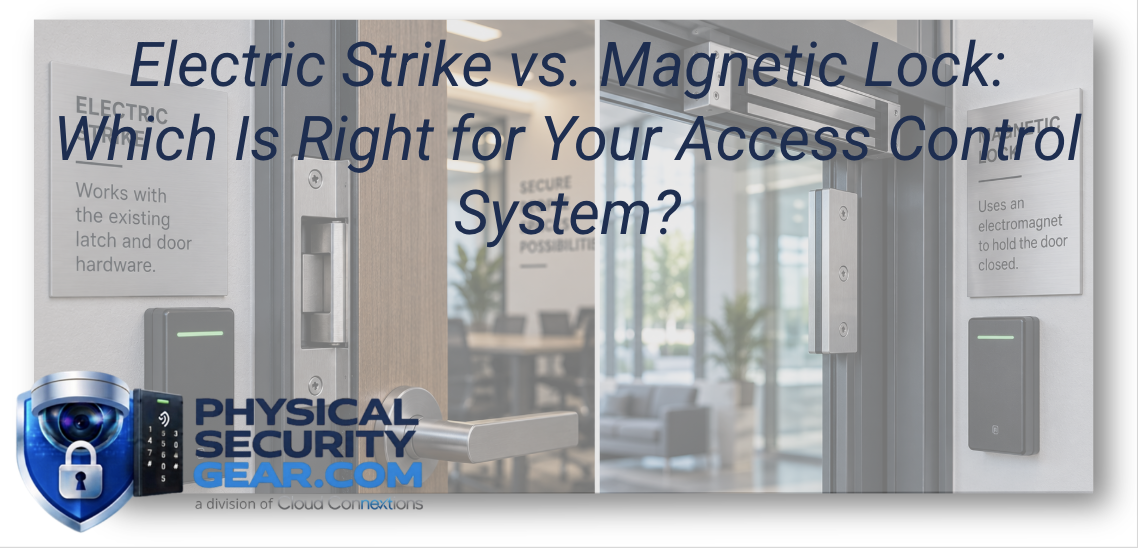
An electric strike modifies the part of the door frame where the lock's latch engages.
In a traditional mechanical opening, the latch sits inside the strike and keeps the door closed.
With an electric strike, an authorized access event can allow that strike to release so the user can open the door.
One reason I like electric strikes in the right application is that they can often work with familiar mechanical door operation.
From the user's perspective, the door can still feel like a normal door.
Present the credential.
Access is granted.
Open the door.
Depending on the hardware and design, free mechanical egress from inside may remain straightforward.
That can make electric strikes a strong option for many office, employee, storage, and commercial doors.
What Is a Magnetic Lock?
A magnetic lock, commonly called a maglock, works differently.
Instead of releasing the mechanical latch in the frame, an electromagnet holds an armature plate and door together.
When power is applied, the magnet holds.
When the system removes power under the designed condition, the door can release.
Maglocks can provide substantial holding force and can be useful on openings where traditional locking hardware is difficult to electrify.
You will often see them considered for certain glass doors, aluminum storefront systems, and other applications where conventional strike hardware may be challenging.
But there is an important distinction.
A maglock changes how the door is being secured.
That means the entire egress and life-safety strategy deserves attention.
Doug's Rule: Do Not Choose the Lock Before You Understand How People Get Out
Access control discussions tend to focus heavily on how people get in.
I care just as much about how they get out.
People should not need to solve an access-control puzzle during an emergency.
Depending on the opening and applicable requirements, a system may involve components such as:
- Request-to-exit devices
- Push-to-exit hardware
- Motion sensors
- Panic hardware
- Fire alarm interfaces
- Emergency release requirements
The correct design depends on the door, occupancy, local code requirements, and the authority having jurisdiction.
That is why I would never recommend selecting a maglock simply because it looks easier to install.
The whole opening has to work correctly.
Fail-Safe and Fail-Secure Matter Too
You will hear these terms quickly when discussing electrified locks.
A fail-safe locking arrangement generally unlocks when power is removed.
A fail-secure arrangement generally remains mechanically secure when power is removed while still allowing required egress from the protected side.
Which approach belongs on a particular opening depends on what the door protects and how life-safety requirements apply.
For example, the security priorities of an exterior employee entrance may be different from those of another controlled opening deeper inside a facility.
This is not something I would standardize with one blanket rule for every door.
The Reader Does Not Make the Door Secure
This sounds obvious, but it gets missed.
A beautiful reader mounted beside a poorly functioning door does not create good access control.
The complete opening matters:
Reader
Credential
Controller
Locking hardware
Door position monitoring
Request to exit
Power
Door closer
Mechanical hardware
The physical door and frame
That is why we framed our earlier article, What Do You Actually Need for a Commercial Access Control System? around the entire system rather than the badge reader alone.
Existing Panic Hardware Changes the Conversation
Commercial doors often already have exit devices or panic hardware.
I don't want to ignore that existing hardware and simply bolt another locking device onto the opening.
Sometimes the better answer is electrifying or integrating with the appropriate existing hardware rather than trying to work around it.
This is exactly why site surveys matter.
A photo of the reader location tells me very little.
I want to see:
the door,
the frame,
the hinges,
the closer,
the latch,
the exit hardware,
and how the opening is currently used.
Glass Doors Can Require a Different Approach
Glass and storefront entrances are a common reason this question comes up.
There may not be a conventional hollow-metal frame with plenty of space for the type of strike you initially imagined.
That can push the project toward other locking approaches.
But again, I would not jump directly to:
“Glass door equals maglock.”
The existing hardware, frame, door construction, egress requirements, aesthetics, and security goals still need to be evaluated.
There can be several ways to solve an opening.
The cleanest-looking answer is not necessarily the best operational answer.
Door Position Monitoring Is Worth Considering
Knowing that access was granted is one thing.
Knowing what the door actually did is another.
A door position sensor can help the system understand whether the opening is:
Open.
Closed.
Held open.
Potentially forced open.
That information can become extremely useful.
Imagine a credential is successfully presented at 6:14 PM.
The system expects the door to open and close.
Instead, it remains open for ten minutes.
That is different from a normal access event.
Once cameras are part of the environment too, that event can become even easier to investigate.
We covered that larger workflow in our recent article on integrating video surveillance and access control.
Think About After-Hours Behavior
How should this door behave at 2:00 PM?
Now ask the same question at 2:00 AM.
Should employees still be able to enter?
Only certain employees?
Should the door immediately generate an alert if forced?
Should security receive notification if it is held open?
Should video be associated with the event?
The physical lock is only one component of that security policy.
Modern access control becomes much more valuable when the hardware supports the rules the organization actually wants to enforce.
Credential Choice Does Not Change Bad Door Hardware
Maybe employees will use cards.
Maybe fobs.
Maybe mobile credentials.
We covered those tradeoffs in Key Cards, Fobs, or Mobile Credentials: Which Access Credential Is Right for Your Business?.
But whichever credential you choose, it ultimately sends the same basic message:
This person is authorized. Release the opening according to its configuration.
If the locking hardware was poorly selected, a better credential does not fix it.
Power Loss Should Be Discussed Before Installation
Ask this question early:
What happens to this door if power goes out?
Not after installation.
Before.
The answer affects security, egress, backup power planning, and how the opening should be designed.
For some environments, maintaining security during an outage is extremely important.
For others, releasing the opening under certain conditions may be required.
The correct answer depends on the application and applicable requirements.
The point is that somebody should intentionally answer the question.
One Hardware Standard May Not Fit Every Door
I like standardization when it makes operations easier.
But access control is an area where people can take standardization too far.
An organization may want consistent:
credential technology,
reader family,
management platform,
administration,
permissions,
and reporting.
That makes sense.
It does not necessarily mean every controlled door should use the identical locking device.
Your main lobby entrance and an interior storage room do not necessarily need the same hardware architecture.
Standardize the experience and management model.
Let the physical opening determine the right hardware.
What About Doors That Already Work?
If a door already has good commercial hardware, I want to know whether we can preserve that investment.
Maybe the opening can be electrified without replacing everything.
Maybe a component needs to change.
Maybe the existing door is already well suited to the new access-control system.
Or maybe the hardware has reached the point where trying to reuse it creates more problems than savings.
I would rather make that decision door by door than begin with a predetermined rip-and-replace plan.
Electric Strike or Maglock?
If you want the simplified version:
An Electric Strike May Make Sense When
The existing mechanical lock and door configuration support it, conventional door operation is desirable, and the opening can be properly electrified through the frame.
A Magnetic Lock May Make Sense When
The door construction or application makes other electrified locking approaches difficult, and the complete egress, power, release, and life-safety design supports the use of a maglock.
But I would treat those as starting points.
Not purchasing rules.
What I Would Want to See Before Recommending Either One
If you are trying to determine the right locking hardware, send us:
- Photos of both sides of the door
- A close photo of the latch and frame
- Existing exit or panic hardware
- Door and frame material
- Whether the opening is exterior or interior
- How employees currently exit
- Whether the door is fire rated, if known
- Existing access-control equipment
- What should happen during a power outage
- Whether cameras or alarms are also involved
That gives us a much better starting point than:
“I need a maglock.”
The Bottom Line
Electric strikes and magnetic locks can both have a place in commercial access control.
But they solve the physical locking problem differently.
An electric strike works with the latch at the door frame.
A magnetic lock holds the door through an energized magnet.
Which one belongs on your door depends on much more than product preference.
Consider:
Door construction.
Existing hardware.
Egress.
Power behavior.
Life safety.
Door monitoring.
How the opening is actually used.
Do not build the access-control system around the reader and figure out the door afterward.
The door is where the security decision physically becomes real.
Planning an Access-Control Door?
Start with the opening itself.
Send us pictures of the door, frame, existing hardware, and reader location along with a description of how people should enter and exit.
We can help narrow down the hardware approach before equipment is ordered.
Explore Access Control to begin building the broader system.
For projects involving multiple controlled doors, new construction, renovation, cabling, video integration, or multi-location standards, Cloud Connextions can help evaluate the complete environment rather than treating each door as an isolated hardware purchase.
Continue Your Research
- What Do You Actually Need for a Commercial Access Control System?
- Key Cards, Fobs, or Mobile Credentials: Which Access Credential Is Right for Your Business?
- Why Cybersecurity Matters in Physical Security
- Can I Reuse My Existing Security Cameras?
- How Many Security Cameras Does My Building Actually Need?
The right access-control hardware is not the lock somebody prefers. It is the hardware that makes that specific door secure, usable, code-compliant, and supportable.