
How Should You Secure Deliveries, Loading Areas, and Employee Entrances?
Posted by Doug Beck: Physical Security Gear on 9/18/2026
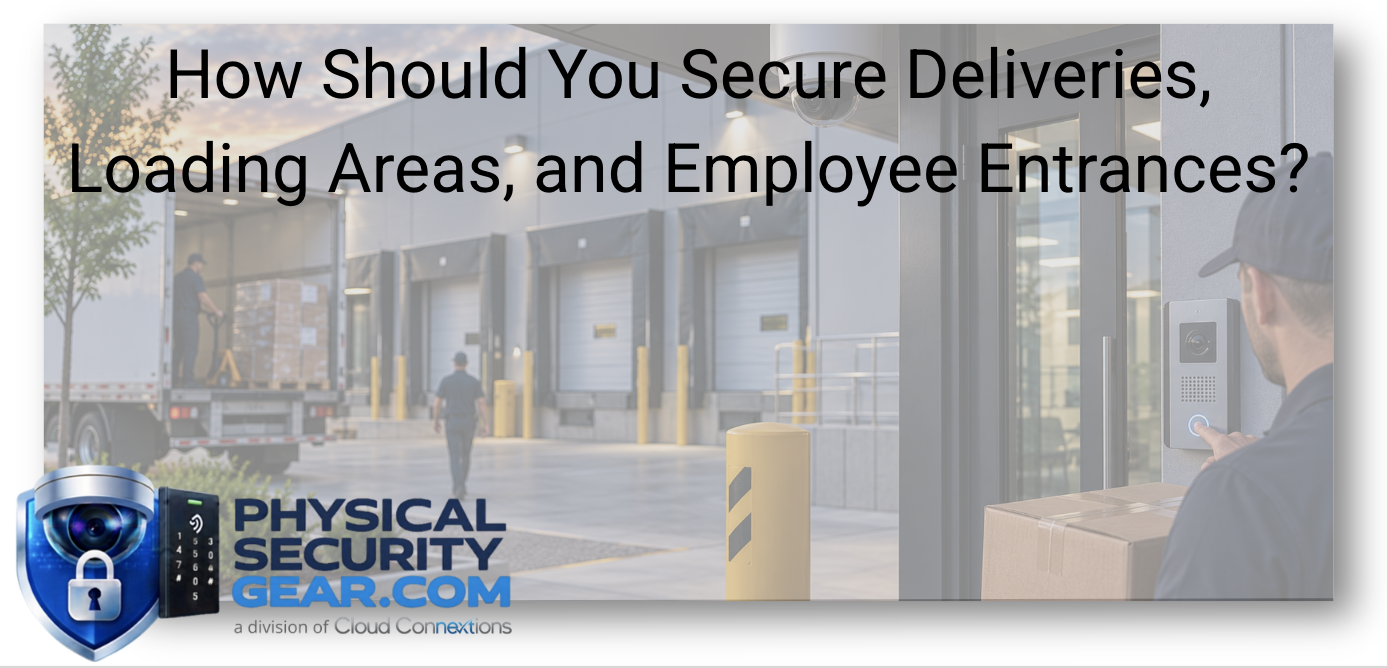
Start With How People Actually Move Through the Property
Written by Doug Beck
When someone asks me how to secure a commercial building, it's not just the front entrance that I want to see.
I want to see the employee door.
The loading dock.
Where UPS and FedEx actually leave packages.
Where contractors enter.
Where trucks wait.
Which rear door employees prop open when they are moving equipment.
Those areas often tell me much more about the real security environment than the polished lobby at the front of the building.
The question is not simply:
“Do we have a camera there?”
I want to know:
Who comes through this area, why are they there, what should they be allowed to do, and what happens when something falls outside the normal workflow?
Once we understand that, the security technology becomes much easier to select.
Not Every Entrance Should Work the Same Way
One of the first things I would do is separate the different types of traffic moving through the property.
The main lobby may serve customers, visitors, and candidates.
An employee entrance may primarily serve staff and maintenance personnel.
A loading dock could see freight carriers, warehouse employees, vendors, and drivers throughout the day.
A package area may have couriers coming and going without ever needing access to the rest of the facility.
Those are completely different workflows.
I would not automatically use the same security approach at all four.
Employee Entrances: Start With Authorized Access
For an employee entrance, the first question is usually pretty straightforward:
Who should be able to open this door?
That is where Access Control becomes important.
A commercial access-control system can help manage:
- Who has access
- Which entrances they can use
- When access is permitted
- Different employee groups
- Temporary permissions
- When access should be removed
But access control does not necessarily tell the whole story.
A valid credential may have been presented.
That does not tell me whether three people followed the employee through the door.
That is where another layer may be useful.
Add Video When Seeing the Event Changes the Answer
Video can provide context around entrances, loading areas, and delivery locations.
At an employee entrance, I may want to know:
Who actually entered?
At a loading dock:
Which truck was there?
At a delivery area:
Was the package actually dropped off?
At a rear entrance:
Was someone waiting around the door before an employee arrived?
Those are different camera jobs.
That is why I would not simply put the same camera everywhere.
You can explore Video Security solutions for indoor, outdoor, parking, perimeter, and specialty applications.
Don't Make One Camera Do Everything
This is something I would pay attention to during a site review.
A camera overlooking an entire loading dock may give you great situational awareness.
That does not necessarily mean it gives you enough detail to identify a person standing at the employee door.
Likewise, a camera positioned for facial detail at the entrance may not tell you what truck entered the yard.
I would rather give each camera a clear job.
For example:
Employee entrance: Who came through this door?
Loading dock: What activity happened around this dock?
Vehicle entrance: Which vehicles entered or exited?
Package area: Who delivered or removed the package?
That usually creates much more useful video than simply trying to maximize square-foot coverage.
Loading Docks Are Usually Their Own Security Problem
Loading areas can be some of the most complicated parts of a commercial property.
You may have:
- Outside drivers
- Warehouse employees
- Open overhead doors
- Inventory moving in and out
- Temporary workers
- Vendors
- Vehicles
- After-hours deliveries
- Exterior storage
So I would want to understand how the dock works during a normal day before recommending equipment.
When is it active?
Who is allowed there?
Are doors routinely open?
Do drivers enter the building?
Where do they wait?
Is valuable inventory sitting near an exterior opening?
What changes after hours?
Those answers will determine whether the area needs video, access control, intrusion detection, intercom, or some combination.
Field Observation: The Written Process and the Real Process May Be Different
This is why I like looking at how the facility actually operates.
The policy may say delivery drivers report to one entrance.
In reality, employees may wave them through another door because it is faster.
The procedure may say an employee entrance stays secured.
In reality, someone props it open during shift change.
The building plan may show a designated package area.
In reality, packages are stacked beside the rear door.
That does not necessarily mean employees are doing something wrong.
It may mean the security workflow does not fit the work being done.
Before adding more technology, I want to understand where people are working around the existing process and why.
Does Every Driver Really Need to Come Inside?
This is another question I would ask.
Sometimes we give people building access because that is simply how the process has always worked.
But does every delivery driver need to walk into the facility?
Could some deliveries be handled through:
- A designated package area
- Intercom communication
- Controlled entry
- Visitor check-in
- A mailroom process
- Video verification
Reducing unnecessary access can sometimes improve security without making the delivery process harder.
The goal is not to put more locked doors between people and their job.
It is to give people access to only the areas they actually need.
Intercom Can Solve a Very Practical Problem
There are plenty of entrances where I do not necessarily want to automatically unlock the door just because someone shows up.
I may want an employee to speak with the person first.
An intercom can make sense for:
- Delivery entrances
- Vendors
- Contractors
- After-hours arrivals
- Employee doors used by outside personnel
- Loading dock access
The questions are simple:
Who are you?
Why are you here?
Who are you meeting?
Where are you supposed to go?
That communication can be far more useful than blindly unlocking a door.
Our Workplace Safety solutions include Intercom & Announcements, Guest & Check-In, Employee Safety, and Mailroom applications.
When I Would Add Intrusion or Perimeter Detection
Not every loading area needs another sensor.
I would start considering Alarm and Intrusion solutions when the concern extends beyond somebody opening the building.
For example:
- Someone enters a loading yard after hours
- Activity occurs around exterior equipment
- A restricted area should be empty overnight
- Vehicles enter when the facility is closed
- Someone approaches rear entrances outside normal hours
A door contact tells you someone opened the door.
Perimeter detection may tell you someone entered the area before they ever reached it.
Whether that earlier warning is worth adding depends on what you are protecting.
Packages Create Their Own Workflow
Package security gets overlooked because deliveries are such a routine part of the day.
But when something goes missing, the questions appear quickly.
Was it delivered?
Where was it left?
Who was in the area?
Who picked it up?
Was it brought inside?
Packages may be:
- Left unattended
- Delivered to inconsistent locations
- Picked up by the wrong person
- Stored temporarily
- Dropped off after hours
- Difficult to trace later
The technology only helps if the process itself is clear.
I would rather have one predictable delivery location with the right visibility than five places around the building where packages might appear.
Employee Safety Belongs in This Conversation
Rear entrances and loading areas are not only security concerns because of theft or unauthorized access.
Employees use these spaces too.
Someone may arrive before sunrise.
Another employee may leave after everyone else is gone.
Warehouse staff may move between the building and exterior areas.
People may be walking around trucks or working in isolated parts of the property.
I would look at:
- Lighting
- Visibility
- Controlled access
- Camera coverage
- Communication
- After-hours activity
- Whether someone can call for help
- Vehicle and pedestrian interaction
Sometimes the security problem and the employee-safety problem are the same problem viewed from two different directions.
What About Vehicles?
For warehouses, distribution facilities, commercial campuses, dealerships, loading yards, and some larger properties, vehicles may be one of the most important parts of the security design.
But again, I would define the question first.
Do you need to know:
- That a vehicle entered?
- Which vehicle entered?
- When it arrived?
- Where it went?
- How long it remained?
- Whether it belonged there?
Those are increasingly specific requirements.
A general parking-lot camera may help with one.
It may not solve all of them.
The application should determine the camera and analytics, not the other way around.
A Practical After-Hours Delivery Example
Imagine a driver arrives at a loading area at 8:30 PM.
The facility is largely closed.
A useful workflow might look something like this:
The vehicle enters the delivery area.
Video provides visual context.
After-hours activity triggers the appropriate awareness.
The driver uses an intercom rather than entering through an employee door.
An authorized employee verifies the delivery.
If access is required, it is limited to the appropriate entrance or area.
Video documents what occurs around the dock.
That is a coordinated security process.
Notice that the value is not coming from one magical product.
Each part of the system is doing a specific job.
Don't Build Security Employees Have to Defeat to Get Their Work Done
This is probably one of the biggest things I would watch.
If a process makes normal work too difficult, people will find a faster way.
That is how you end up with:
- Propped doors
- Shared badges
- Delivery drivers wandering through employee entrances
- Contractors being waved through
- Loading areas left unsecured
- Visitor processes nobody follows
When that happens, I would not immediately blame the employee.
I would ask whether the workflow was designed well in the first place.
The strongest physical-security systems make the secure action the easiest reasonable action.
Here's What I Would Want to Know About Your Facility
If you asked me to help improve these areas, I would probably start with a handful of practical questions.
Where do employees actually enter?
Not where the drawing says they enter.
Where do deliveries actually arrive?
And does that change depending on the carrier?
Does anyone outside the organization need to enter the building?
If so, how far?
What happens after hours?
Are deliveries still expected?
Where are the biggest visibility gaps?
People? Vehicles? Packages? Inventory?
What are employees currently working around?
This is often one of the most valuable questions.
What existing technology is already installed?
We may not need to start over.
Once those answers are clear, we can usually narrow the technology considerably.
The Bottom Line
Employee entrances, loading docks, delivery areas, and package locations deserve more thought than simply putting a camera on the wall.
They involve different people.
Different hours.
Different levels of access.
Different operational pressures.
And often completely different security questions.
I would start by understanding the workflow.
Then decide where access needs to be controlled, where video adds context, where communication would help, and whether after-hours activity needs another layer of detection.
The goal is not to add more security products.
It is to create a process where employees can do their jobs, legitimate visitors and deliveries can get where they need to go, and unusual activity is much easier to identify.
Where Are You Losing Visibility or Control?
If employee entrances, loading docks, deliveries, or package areas are creating a security gap, tell us how the area works today.
Send us:
- The type of facility
- Where employees enter
- Where deliveries arrive
- Whether vendors or drivers enter the building
- Whether after-hours deliveries occur
- What existing cameras or access control are already installed
- The specific problem you are trying to solve
We'll help you narrow down which security layers actually make sense before you start buying equipment.
Depending on the application, that may involve Video Security, Access Control, Alarm and Intrusion Detection, Workplace Safety, or a combination.
But the recommendation should come after we understand the workflow, not before.
Continue Your Research
- Ultimate Guide to Visitor Management
- What Do You Actually Need for a Commercial Access Control System?
- Basic Intrusion vs. Advanced Intrusion vs. Perimeter Detection
- What Happens After Someone Tries to Enter After Hours?
- How Many Security Cameras Does My Building Actually Need?
- Why Cybersecurity Matters in Physical Security