Migrating from Zoom Rooms to Google Meet: What Changes and What Can You Reuse?
Posted by Video Conference Gear on 9/1/2026
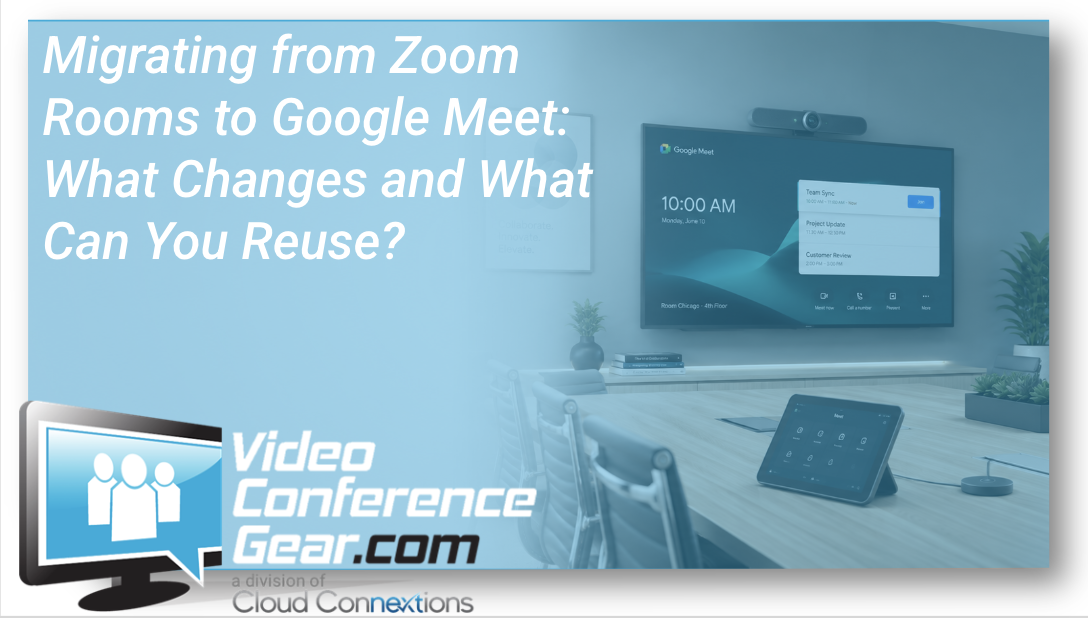
Moving conference rooms from Zoom Rooms to Google Meet can look like a simple platform change.
In reality, the room may have been designed around a very specific combination of compute, controllers, cameras, microphones, speakers, displays, cabling, and platform-certified hardware.
That means the right question is not:
"What Google Meet kit replaces our Zoom Room?"
It is:
"What does this room need to do today, and which parts of the existing system still make sense?"
That distinction can save organizations from unnecessary replacement costs, compatibility issues, and another room redesign shortly after the migration is complete.
Start With Why You Are Moving to Google Meet
Before selecting hardware, understand what is driving the change.
Organizations may be moving because:
- Google Workspace has become the primary productivity platform
- Employees spend most of their day in Google Meet
- IT wants to reduce the number of collaboration platforms it manages
- The organization is standardizing conference rooms
- Existing Zoom Room hardware is aging
- A merger or acquisition introduced a different technology standard
- Leadership wants the conference room experience aligned with employee workflows
The reason matters because it defines what success should look like.
A company converting three rooms because it adopted Google Workspace has different requirements than an enterprise trying to establish a new room standard across dozens of locations.
Do Not Assume Existing Hardware Will Transfer
This is one of the most important considerations in any platform migration.
Your existing Zoom Room may include perfectly functional hardware, but that does not mean every component can simply be moved into a Google Meet architecture.
Depending on the manufacturer and model, certain room systems are designed and certified around a particular collaboration platform.
That can include:
- Room compute
- Appliances
- Touch controllers
- Cameras
- Audio devices
- Scheduling displays
- Manufacturer-specific room kits
Some peripherals may work across multiple platforms.
Others may be tightly connected to the platform for which the room was originally designed.
There is also a difference between hardware that can technically send video or audio to a computer and hardware that is appropriate for a dedicated, supported Google Meet room environment.
That distinction needs to be verified before purchasing anything.
Inventory the Complete Room
Before deciding what gets replaced, document what is currently installed.
We recommend capturing:
- Camera manufacturer and model
- Microphones
- Speakers
- DSP or audio processing
- Room computer or appliance
- Touch controller
- Displays
- USB infrastructure
- HDMI distribution
- Mounts
- Cabling
- Scheduling panels
- Control systems
- Approximate installation dates
Photos of the room and equipment can also be extremely useful.
This process often reveals that the conference room is not one system from one manufacturer. It may contain technology from several different vendors that was integrated to support the original Zoom Room.
Each component needs to be evaluated individually and as part of the larger system.
What Can Be Reused?
Potentially quite a bit.
Displays, cameras, microphones, speakers, cabling, and other peripherals may still have useful life depending on their age, compatibility, condition, and the architecture of the new Google Meet solution.
But reuse should be based on more than whether the device still powers on.
We want to understand:
Is it technically appropriate for the new platform?
Is it still supported?
Does it provide the right coverage?
Does keeping it create limitations elsewhere in the system?
How much useful lifecycle does it realistically have left?
This is where organizations can either protect their previous investment or accidentally carry old problems into a new platform.
Compatibility Is Only Part of the Decision
A camera may technically work.
That does not necessarily mean it is still the right camera.
Imagine a room originally designed five years ago for six people.
Today, the same room has a larger table, more participants, and significantly more hybrid meetings.
Keeping the old camera because it can connect to the new system may preserve hardware but deliver a poor user experience.
The same applies to audio.
A microphone system may integrate successfully while no longer providing adequate coverage for the way the room is used today.
Platform migration should include both technical compatibility and actual room performance.
Evaluate Camera and Audio Coverage Again
Changing platforms is a good time to reassess the physical room.
For cameras, consider:
- Distance to the nearest participant
- Distance to the farthest participant
- Field of view
- Room depth
- Table size
- Participant count
- Framing requirements
- Speaker tracking or intelligent camera features
For audio, consider:
- Microphone coverage
- Table configuration
- Ceiling height
- Speaker coverage
- Room acoustics
- DSP requirements
- Current user complaints
A component that worked reasonably well under the old system may still be the weakest part of the new one.
Room Compute and Controls May Need the Most Attention
In many migrations, the camera and displays are not the biggest challenge.
The room compute and touch-control architecture may be where the real change occurs.
Your Zoom Room may use a dedicated Windows PC, appliance, tablet controller, or manufacturer-specific system.
Google Meet may require a different room-compute configuration and control experience.
Those changes can affect how other devices connect to the room.
This is why it is risky to begin purchasing replacement products before understanding the complete architecture.
One incorrect assumption about the controller, compute device, or USB path can create a series of compatibility problems later.
Think About Hardware Lifecycle Too
Platform migration is also an opportunity to look at the age of the equipment.
Suppose a four- or five-year-old camera can technically be reused.
That may be a perfectly reasonable decision.
But if the device is approaching end of support, the organization should understand that before building a newly standardized Google Meet room around it.
Otherwise, IT may complete the migration and then find itself reopening the same room months later to replace another aging component.
Sometimes reuse is smart.
Sometimes replacement is smarter.
The decision should be intentional.
User Experience Matters
Technology teams naturally focus on compatibility.
Employees focus on whether the meeting works.
The new room should make it easy to:
- Start a meeting
- Join scheduled calls
- Share content
- Control cameras and audio
- Invite outside participants
- Understand what to touch
- Get help when something goes wrong
If every converted room behaves differently, the migration may create more support problems than it solves.
This is particularly important for organizations with multiple offices.
A platform transition is often the ideal time to create a repeatable room standard.
Pilot Before Rolling Out Everywhere
For larger migrations, build a representative room first.
Test the complete experience.
Evaluate:
- Camera performance
- Audio quality
- Content sharing
- Touch controls
- Guest meetings
- Device management
- Remote support
- User feedback
- IT administration
Then use what you learn to improve the design before deploying it across additional rooms.
A good pilot can prevent dozens of repeated mistakes.
This Is Becoming a Common Migration Conversation
VideoConferenceGear.com and Cloud Connextions are increasingly helping organizations navigate platform changes like this.
The value is not simply identifying which Google Meet product replaces a Zoom product.
It is helping determine:
- What existing hardware can remain
- What should be replaced
- What is supported
- What is approaching end of life
- Whether the camera and audio still fit the room
- What platform architecture makes sense
- How to create a repeatable room standard
There are often more dependencies than initially expected.
Those dependencies are much easier and less expensive to solve during planning than during installation.
Start With Discovery
Before ordering a Google Meet room kit, take a look at the room as a complete system.
Understand what is there.
Understand why the organization is changing platforms.
Understand how employees use the room now.
Then decide what stays and what changes.
The right migration may reuse a significant amount of your existing investment.
Or it may reveal that the room has outgrown the technology that was originally installed.
Either outcome is fine if the decision is based on the actual requirements.
The goal is not simply to convert a Zoom Room into a Google Meet room.
The goal is to create a room that works properly for the people using it today and gives IT a system it can confidently support going forward.