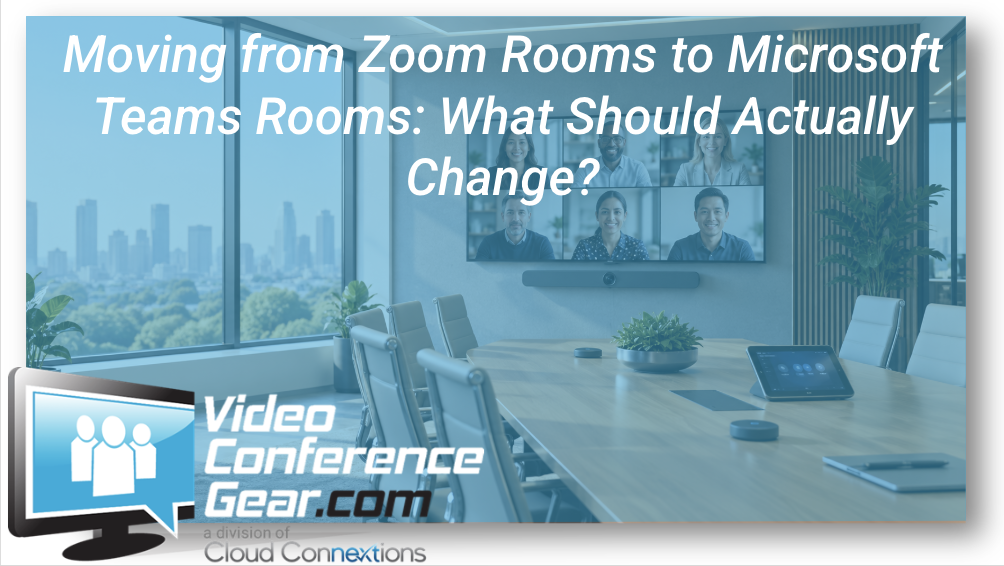
Moving from Zoom Rooms to Microsoft Teams Rooms: What Should Actually Change?
Posted by Doug Beck: Video Conference Gear on 9/11/2026
Before You Replace Everything, Figure Out What Still Works
Written by Doug Beck
A few years ago, the conversation was usually pretty simple:
Zoom or Teams?
Today, I think that question misses a big part of what organizations are actually dealing with.
A company may have perfectly functional Zoom Rooms that were installed three, four, or five years ago. Meanwhile, Microsoft Teams has become where employees spend most of their day. Internal meetings originate there. Microsoft 365 has expanded across the organization. IT starts asking whether the conference rooms should follow the same direction.
Then someone asks:
“Do we need to replace all of our Zoom Rooms?”
My first answer would be:
Not until we look at what is actually in those rooms.
Changing platforms does not automatically mean replacing every camera, microphone, display, cable, and piece of hardware you already own.
I would rather understand what is working, what is not, and what the room needs to accomplish going forward.
Start With Why You Are Considering the Change
Before I recommend replacing anything, I want to know what problem we are trying to solve.
Is Teams now your primary meeting platform?
Are employees confused because some rooms operate differently than others?
Is IT trying to reduce the number of platforms it manages?
Is the existing Zoom Room hardware already approaching refresh?
Are users regularly bypassing the room system and plugging in their laptops anyway?
Are you opening new locations and trying to establish a standard?
Those are meaningful reasons to reconsider the room.
“Everyone else seems to be moving to Teams” is not.
If the current room works well and still matches the workflow, I would not change it just to change it.
Field Note: Watch What Users Are Already Doing
One of the easiest ways to understand whether a room is still doing its job is to watch how employees use it.
If you have a dedicated Zoom Room but everyone walks in and immediately plugs in a laptop, I want to know why.
Maybe most of their meetings are now Teams.
Maybe outside meetings are difficult to join.
Maybe content sharing is cumbersome.
Maybe the room is inconsistent with other spaces.
Or maybe users simply do not understand how to operate it.
Before spending money, figure out whether you have a technology problem, workflow problem, or training problem.
Those require very different solutions.
Inventory the Room Before Building the Replacement
A Zoom Room is not one product.
Depending on how it was originally designed, you may have:
- Displays
- Cameras
- Microphones
- Speakers
- Room compute
- Touch controllers
- Scheduling panels
- USB devices
- HDMI connectivity
- Network infrastructure
- Mounting hardware
- Structured cabling
Some of that equipment may still have years of useful life.
Other pieces may be exactly what is holding the room back.
That is why I would never develop a migration budget simply by saying:
“We have 20 Zoom Rooms, so we need 20 new Teams Room kits.”
First find out what those 20 rooms actually contain.
Can You Keep the Camera?
Possibly.
A modular Zoom Room may use a separate USB camera that could still work in a different room architecture if the intended system supports it.
An appliance-based room may be different because the camera, audio, compute, and the conferencing platform are more tightly connected.
But compatibility is only one part of the decision.
I would also ask:
- Is the camera still giving us the coverage we need?
- Has the room layout changed?
- Are people sitting farther away than they used to?
- Does the camera handle framing well?
- Are users complaining about the experience?
- Is there a newer camera capability we actually need?
If the existing camera works and fits the new architecture, keeping it may make perfect sense.
If it needs to change, explore our Video Conferencing Camera solutions for traditional conferencing cameras, wide-angle systems, huddle-room cameras, and all-in-one options.
Want to Compare Camera Options?
This is where a live conversation can be more useful than another specification sheet.
Use the chat on our site and tell us:
- Room dimensions
- Seating capacity
- Distance to the farthest participant
- Current camera
- Meeting platform
- What you are trying to improve
If we have a relevant camera operating in one of our conference-room environments, we may be able to show it live. If not, we can often demonstrate something comparable or help explain the differences that matter for your room.
Seeing framing, field of view, or tracking behavior can eliminate a lot of uncertainty.
I Would Be Very Careful About Replacing Good Audio
Audio is one area where I would not replace equipment simply because the meeting platform changed.
If you already have a well-designed microphone and speaker system that covers the room correctly, I want to see whether we can keep it.
Installed audio can represent a meaningful part of the original investment.
The questions I would ask are practical:
- Can everyone at the table be heard?
- Are remote participants complaining about echo?
- Does the far end sound different from the near end?
- Has furniture or seating changed?
- Is the room too large for the existing microphone coverage?
- Are tabletop microphones creating clutter?
- Would ceiling or array audio improve the space?
If the answer is that the current audio works, great.
If not, the migration is a good time to fix it.
Explore Conference Room Audio solutions including tabletop, overhead, array, wireless, and USB options.
Audio Is Hard to Buy From a Spec Sheet
If you are choosing between different audio approaches, ask our team what we currently have available to demonstrate.
When possible, hearing a tabletop system, ceiling setup, array, or comparable room configuration can tell you much more than reading microphone pickup specifications.
You may not need a demo unit shipped across the country simply to narrow the direction.
The Compute and Controller Are Often Where the Platform Really Changes
This is where a Zoom-to-Teams migration can become more substantial.
The room compute, operating platform, and controller have a major impact on how the room behaves.
If the organization has already decided that Teams should be the native room experience, the next question is:
What type of Teams Room are we actually building?
Our Microsoft Teams Room Solutions include options for different room sizes rather than treating every space the same way.
This is where I would look closely at:
- Room size
- Number of participants
- Camera and audio requirements
- Existing peripherals
- Controller requirements
- Whether Windows or Android architecture makes sense
- How IT wants to manage the environment
“We want Teams” is the beginning of the room decision, not the end of it.
Don't Automatically Keep the Display Either
Displays are another piece people often assume will stay because they still turn on.
Maybe they should.
But while we are evaluating the room, I would check:
- Is the display large enough for the viewing distance?
- Is one screen enough?
- Would two displays improve how content and participants are shown?
- Is mounting appropriate?
- Has the room layout changed?
- Does interactive collaboration matter?
- Is the existing display appropriate for the next several years?
A display that worked when the room was built may still be completely adequate.
Or it may be one of the reasons people in the back of the room struggle to see shared content.
You can explore Collaboration Room Displays if display replacement becomes part of the refresh.
Room Controllers and Schedulers Solve Different Problems
This is another area worth reviewing during a migration.
The controller inside the room helps users operate the meeting.
The scheduling panel outside the room helps people see availability and often reserve the space.
If you are changing platforms, do not assume both pieces automatically carry over.
Ask:
- How are rooms scheduled today?
- Does the controller still fit the intended architecture?
- Do users understand the workflow?
- Are scheduling panels standardized across offices?
- Should the room-resource experience change with the move to Microsoft 365?
Explore Room Controllers & Schedulers if those pieces are part of the project.
Do You Actually Need to Convert Every Zoom Room?
I would not assume that you do.
If Zoom remains the primary platform for a particular business unit and the room works well, there may be a perfectly good argument for leaving it alone.
Likewise, interoperability may be enough for some spaces.
Imagine a room where:
- Most meetings still originate in Zoom
- Teams invitations are occasional
- Users are comfortable with the current room
- IT is not trying to eliminate Zoom
- Hardware still has useful life
That may not be the room I would convert first.
Spend the budget where the change actually solves something.
When Teams Rooms Start Making More Sense
Now look at the opposite scenario.
Employees spend most of their day inside Teams.
Internal meetings originate there.
Microsoft 365 is embedded across the organization.
Users expect the conference-room experience to behave like the collaboration environment they already know.
IT wants the rooms managed consistently.
That is where a native Microsoft Teams Room starts making much more sense.
The room is finally following the user's workflow instead of making the user adapt to the room.
What If Your Customers Use Everything?
This is where I would pause before forcing the entire environment into one native platform.
Some organizations spend a large portion of their day meeting with customers and partners.
One meeting is Teams.
The next is Zoom.
Then Google Meet.
Then Webex.
In that environment, a BYOD or Cross-Platform Room Solution may deserve serious consideration.
I would ask:
How often do users actually need another platform?
If it is twice a month, that is one thing.
If it is half the room's meetings, that is something else.
Design around the dominant workflow, but make sure the exceptions are not so frequent that they become the actual workflow.
Video Bar or Modular Room?
A migration is also a good time to reconsider whether the existing room architecture still makes sense.
For many small and medium rooms, a Video Bar Solution can simplify the system considerably.
Camera, microphones, speakers, and sometimes native room functionality can all live in a single device.
I like that approach when the room supports it.
But I would not use a video bar everywhere just because it is easy.
Once I see:
- Long conference tables
- Large participant counts
- Difficult acoustics
- Divisible rooms
- Unusual layouts
- Greater camera distances
- More advanced audio requirements
I start looking much harder at modular systems.
The room should determine the architecture.
Best Practice: Measure Before You Shop
If you are considering a room migration, I would want a few basic details before recommending hardware:
- Room dimensions
- Seating capacity
- Table length
- Distance to the farthest participant
- Current camera
- Current audio
- Display size
- Primary platform
- Frequency of outside-platform meetings
That information can eliminate a lot of products immediately.
It is much easier to help someone choose a room system when we know what the room actually looks like.
One Room Is Different From Twenty Rooms
If you are replacing one room, this may be a fairly straightforward conversation.
What can stay?
What has to change?
What product fits?
When you have 20, 50, or 100 rooms, I start looking for patterns.
Which rooms are essentially the same?
Which ones are causing the most support calls?
What hardware is approaching end of life?
Which rooms can use an all-in-one standard?
Which spaces require something more sophisticated?
What infrastructure can be reused?
You may end up with three good room standards rather than 50 individually designed rooms.
That is usually a much more manageable environment.
Don't Let Structured Cabling Become the Surprise
This is one of those pieces nobody talks about until it creates a problem.
The visible technology may change, but the room still depends on:
- Network connectivity
- Power
- USB extension
- HDMI
- Display cabling
- Controller connectivity
- Ceiling audio cabling
- Cable pathways
- Equipment locations
A new Teams Room may require something different from the Zoom Room it is replacing.
That does not necessarily mean ripping everything out.
It means verifying the infrastructure before the new hardware shows up.
Field Note: Keep What Works
If I had to summarize my approach to these projects in one sentence, it would be:
Do not replace good technology just because you are replacing the platform.
Keep the display if it still fits.
Keep the audio if it still sounds good and is supported.
Keep infrastructure that meets the new requirements.
Replace the pieces that no longer support the room experience you are trying to create.
That is a much better use of the budget than assuming every migration starts from zero.
The Best Answer May Be Different From Room to Room
After reviewing the environment, I would not be surprised to end up with something like:
Room A: Keep the existing Zoom Room.
Room B: Convert to a native Teams Room.
Room C: Use BYOD because customer meetings dominate the space.
Room D: Replace the aging appliance with an all-in-one Teams video bar.
Boardroom: Keep the installed audio and displays but replace the compute and controller.
That is not poor standardization.
It is matching technology to the application.
The goal is consistency where consistency helps without forcing the wrong architecture into every space.
Ready to Move a Room to Teams?
If you know the room is moving to Microsoft Teams, start with:
Microsoft Teams Room Solutions
You can also compare:
- Complete Room Solutions
- Video Bar Solutions
- BYOD & Cross-Platform Solutions
- Room Controllers & Schedulers
- Collaboration Room Displays
Still Trying to Figure Out What Can Stay?
Use the chat on our site.
Tell us:
- What room system you have today
- Room size
- Current camera and audio
- Primary meeting platform
- What users are struggling with
- What you are trying to accomplish
If you are comparing cameras, audio systems, or video bars, ask about that too. When we have relevant equipment available, we may be able to show it operating live or demonstrate a comparable solution.
Sometimes a short conversation can save you from replacing equipment that never needed to be replaced.
Converting Multiple Rooms?
That is where Cloud Connextions can help you look beyond the individual hardware purchase.
We can support:
- Existing room assessments
- Microsoft Teams Room design
- Room standards
- Hardware selection
- Structured cabling
- Installation
- Multi-location deployment
- Lifecycle planning
- Managed services
- Ongoing support
My goal would not be to turn every Zoom Room into a Teams Room.
It would be to understand what you already own, how people actually use the rooms, and build the next version around what will work best for your organization moving forward.