
Multi-Sensor Security Cameras Explained
Posted by Physical Security Gear on 9/7/2026
When One Camera Can Replace Four (and When It Shouldn't)
Executive Summary
As organizations look for ways to improve security while managing installation costs, one type of camera is generating more interest than ever before: the multi-sensor camera.
At first glance, they seem almost too good to be true.
One camera.
Multiple lenses.
Extremely wide coverage.
Fewer devices mounted throughout the building.
For the right application, they can be an outstanding investment.
But like every commercial security product, they're not the right solution for every situation.
The goal isn't to install fewer cameras.
The goal is to provide the right coverage with the right level of detail while creating a system that's easier to manage, expand, and support over time.
Understanding where multi-sensor cameras excel and where traditional cameras still perform better can help organizations make more informed purchasing decisions.
What Is a Multi-Sensor Camera?
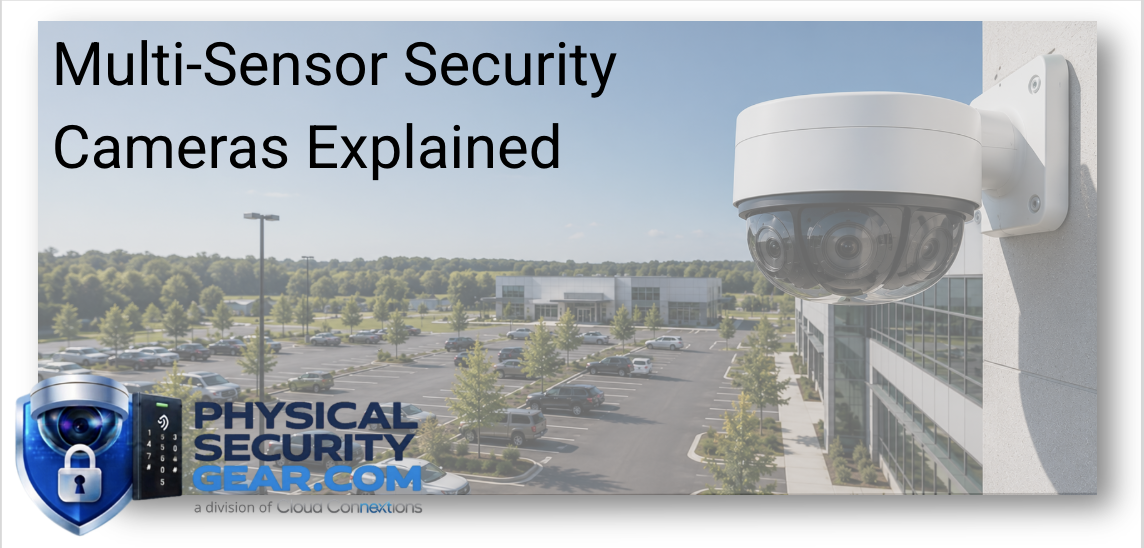
Unlike a traditional surveillance camera with a single image sensor and lens, a multi-sensor camera combines several independent image sensors in one housing.
Each sensor can monitor a different direction simultaneously.
Depending on the model, a single device may provide:
- 180-degree coverage
- 270-degree coverage
- 360-degree coverage
- Multiple independent viewing angles
- Individual image adjustment for each sensor
Rather than relying on one ultra-wide lens, multi-sensor cameras combine multiple high-quality images to provide comprehensive visibility across large areas.
Why Businesses Are Choosing Multi-Sensor Cameras
One of the biggest advantages is coverage.
Instead of installing four separate cameras around the corners of a building, a properly positioned multi-sensor camera may provide the same visibility with a single device.
That can reduce:
- Installation time
- Mounting locations
- Network connections
- Infrastructure requirements
- Long-term maintenance
In many environments, fewer physical devices also create a cleaner architectural appearance.
Where Multi-Sensor Cameras Work Best
We've found multi-sensor cameras perform especially well in locations where broad situational awareness is more valuable than long-distance zoom.
Common applications include:
- Building corners
- Parking lots
- Warehouse interiors
- Manufacturing facilities
- School campuses
- Hotel lobbies
- Distribution centers
- Large retail environments
- Transportation facilities
These locations often benefit from wide-area visibility without requiring multiple overlapping cameras.
Understanding the Trade-Offs
While multi-sensor cameras offer impressive coverage, they don't replace every camera on a project.
A camera designed to monitor an entire parking lot may not provide the same level of facial detail as a dedicated camera focused on a single entrance.
Likewise, identifying a license plate several hundred feet away may require a specialized camera with a different lens entirely.
The question isn't whether one solution is better.
It's whether the camera matches the operational objective.
Coverage and identification are two different design goals.
The best surveillance systems understand the difference.
What We See Most Often
Many organizations initially ask whether multi-sensor cameras can reduce the overall number of cameras they need.
Sometimes they can.
But that's rarely how we approach the conversation.
Instead, we ask:
"What information do you want to capture in this area?"
If the goal is broad situational awareness, a multi-sensor camera may be an excellent solution.
If the goal is identifying individuals entering a secured doorway, another camera may still be required.
Rather than replacing cameras simply to reduce equipment counts, we design systems that capture the right information in the right places.
Advisor's Note
One of the biggest mistakes organizations make is assuming every camera must perform every task.
In reality, commercial surveillance systems are much like a team.
Some cameras provide wide coverage.
Others focus on entrances.
Some monitor parking lots.
Others support investigations with detailed identification.
When each camera has a clearly defined role, the entire system performs better.
Questions We'd Ask Before Recommending Multi-Sensor Cameras
Before specifying multi-sensor cameras, we'd typically discuss:
- What areas require the widest coverage?
- Is broad visibility or detailed identification more important?
- What mounting locations are available?
- Are there network or infrastructure limitations?
- Will AI analytics be used?
- Should the cameras integrate with access control?
- How might the facility expand over time?
Those conversations help ensure each camera supports your operational goals rather than simply filling a space on a floor plan.
The Bottom Line
Multi-sensor cameras have become one of the most effective tools available for organizations needing wide-area surveillance.
When used appropriately, they can simplify installations, reduce infrastructure requirements, improve visibility, and provide outstanding operational awareness.
The best surveillance systems aren't designed around individual products.
They're designed around your building, your workflows, and the information your team needs to make better decisions.
That's why we begin every project by understanding your operational objectives first.
Once those are clear, selecting the right camera becomes much easier.
Continue Your Research
You may also find these resources helpful:
- Ultimate Guide to Commercial Video Surveillance
- What Makes a Commercial Security Camera Different?
- AI Security Cameras Explained
- Dome vs. Bullet Cameras
- PTZ Cameras Explained
- Camera Resolution Guide
- Cloud Video Recording Explained