
PTZ Cameras Explained
Posted by Physical Security Gear on 9/6/2026
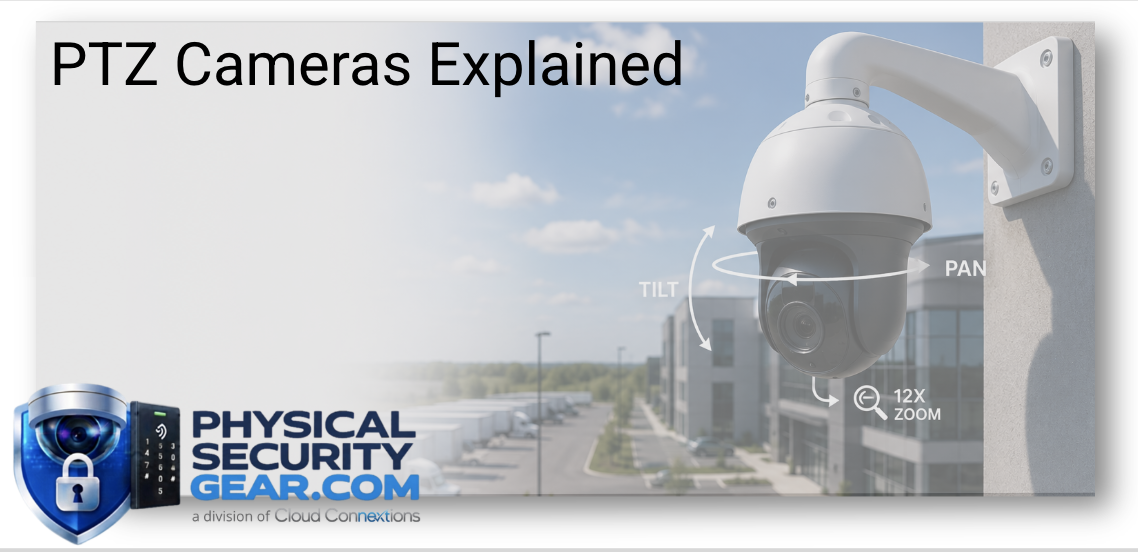
When Pan-Tilt-Zoom Cameras Make Sense and When Fixed Cameras Are the Better Investment
Executive Summary
One of the most recognizable security cameras is the PTZ camera.
Mounted high above parking lots, campuses, stadiums, warehouses, and industrial facilities, these cameras can pan from side to side, tilt up and down, and zoom in on people, vehicles, or activity occurring hundreds of feet away.
They look impressive.
They can cover enormous areas.
And they're often one of the first camera types buyers ask about.
But are they the right choice for your business?
Sometimes, absolutely.
Other times, organizations spend significantly more money on PTZ cameras when a thoughtfully designed fixed-camera system would actually provide better coverage, stronger evidence, and fewer blind spots.
The key isn't deciding whether PTZ cameras are "better."
It's understanding what problem you're trying to solve.
Like every commercial surveillance decision, the right camera depends on your environment, your operational workflows, and the information your team needs when an incident occurs.
What Is a PTZ Camera?
PTZ stands for Pan, Tilt, and Zoom.
Unlike traditional fixed cameras that continuously monitor one field of view, PTZ cameras can be remotely controlled or automatically programmed to:
- Rotate horizontally (pan)
- Move vertically (tilt)
- Zoom in on specific people, vehicles, or activity
- Follow preset patrol routes
- Respond automatically to AI-triggered events
This flexibility allows a single camera to observe a much larger area than most fixed cameras.
However, flexibility doesn't always equal better coverage.
Where PTZ Cameras Excel
PTZ cameras are ideal when security personnel actively monitor live video or when large outdoor areas require dynamic observation.
Common applications include:
- Parking lots
- Distribution centers
- School campuses
- Manufacturing facilities
- Stadiums
- Airports
- Ports
- Utility facilities
- Large commercial campuses
In these environments, operators can quickly investigate suspicious activity without deploying personnel.
Modern AI platforms can even direct PTZ cameras to automatically follow detected vehicles or individuals, reducing response times and improving situational awareness.
The Biggest Misconception About PTZ Cameras
One of the most common misconceptions is that a PTZ camera can replace several fixed cameras.
Sometimes it can.
Often it shouldn't.
A PTZ camera only records where it's looking.
If it's zoomed in on a delivery truck entering the loading dock, it isn't watching the employee entrance behind it.
That's why many commercial deployments combine PTZ cameras with strategically placed fixed cameras.
The fixed cameras continuously record critical areas while the PTZ provides additional investigation capabilities.
Together, they create a far more complete surveillance strategy.
What We See Most Often
Organizations frequently ask us to quote PTZ cameras because they've seen them installed at large facilities.
Once we understand how the building operates, many discover they don't actually need PTZ cameras everywhere.
Instead, we often recommend using fixed AI-enabled cameras to provide continuous coverage while placing PTZ cameras in locations where operators benefit from dynamic viewing.
The result is usually a better system and a more efficient investment.
Technology should support the way your team works, not simply look impressive.
PTZ Cameras and Artificial Intelligence
Modern PTZ cameras become even more valuable when paired with AI-powered analytics.
Depending on the platform, AI can automatically:
- Detect people entering restricted areas
- Follow vehicles across parking lots
- Zoom in on unusual activity
- Track movement across multiple zones
- Alert operators to predefined events
Instead of relying entirely on manual control, AI helps ensure important activity isn't missed while allowing security personnel to focus on decision-making.
Advisor's Note
One question we often ask during discovery is:
"Will someone actually be watching these cameras in real time?"
If the answer is no, a PTZ camera may not deliver the value many organizations expect.
If the answer is yes, and your team actively monitors live video, PTZ cameras can become an incredibly powerful operational tool.
Understanding how the system will actually be used almost always leads to a better design than simply selecting the most advanced hardware.
Questions We'd Ask Before Recommending PTZ Cameras
Before recommending PTZ cameras, we'd typically ask:
- Who will actively monitor live video?
- What areas require dynamic observation?
- Would fixed cameras provide continuous coverage more effectively?
- Are AI-powered tracking features important?
- What level of zoom is required?
- Are there lighting or weather considerations?
- Will PTZ cameras integrate with access control or other security systems?
- How do you expect your surveillance system to expand over time?
Those conversations help ensure PTZ cameras are deployed where they create the greatest operational value.
The Bottom Line
PTZ cameras are one of the most powerful tools available in commercial video surveillance, but they're not the right solution for every application.
The best surveillance systems combine the strengths of fixed cameras, AI-powered analytics, and PTZ technology to provide complete visibility while supporting the way your organization operates.
Rather than asking whether you need PTZ cameras, the better question is:
Where can PTZ technology provide the greatest operational advantage?
When that question is answered first, designing the right surveillance system becomes significantly easier.
Continue Your Research
Continue exploring these related resources:
- Ultimate Guide to Commercial Video Surveillance
- What Makes a Commercial Security Camera Different?
- AI Security Cameras Explained
- Dome vs. Bullet Security Cameras
- Multi-Sensor Cameras Explained
- Camera Resolution Guide
- Cloud Video Recording Explained